
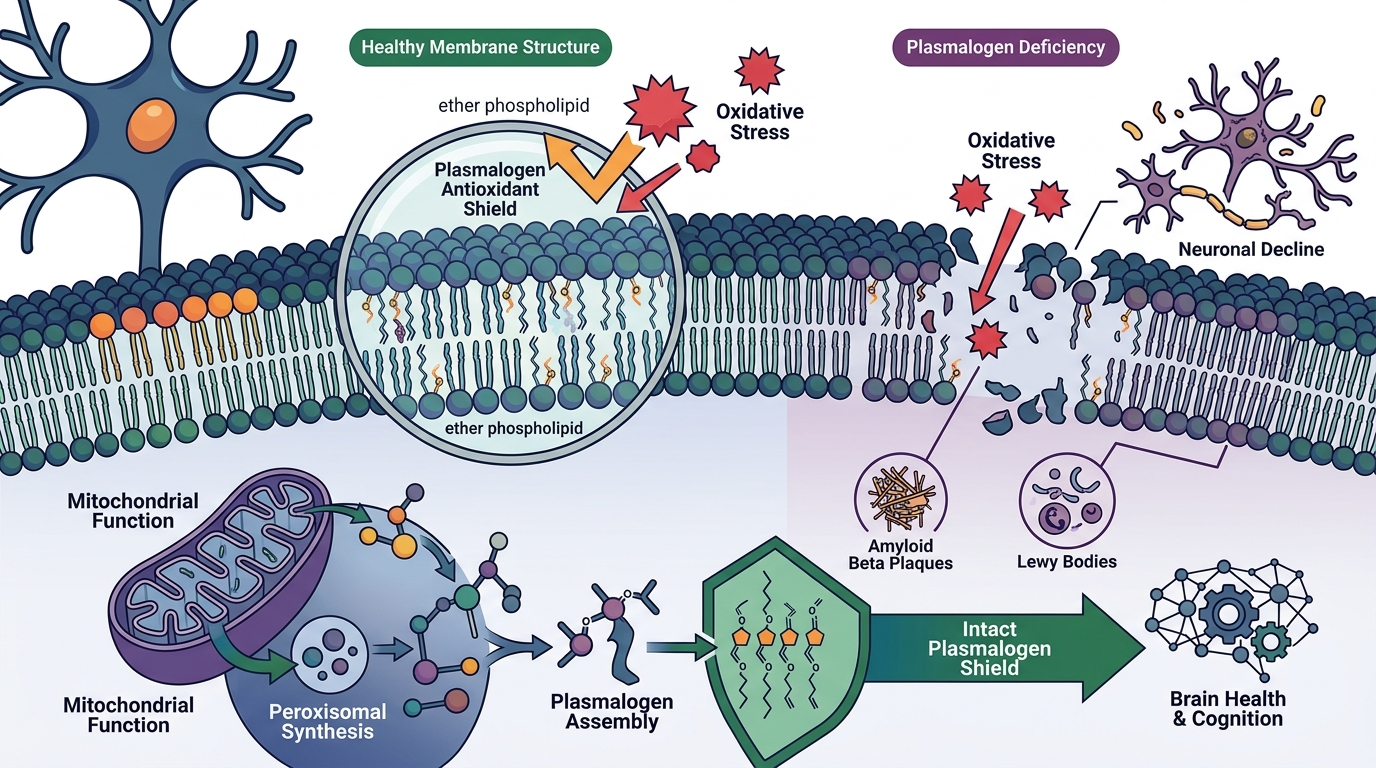
Plasmalogens are specialized ether phospholipids that serve as the primary antioxidant defense in the brain's cell membranes. Recent research indicates that declining plasmalogen levels are not merely a symptom of neurodegeneration but a critical driver of neuronal damage in conditions like Alzheimer's and Parkinson's disease. As oxidative stress overwhelms the brain's natural defenses, the loss of these specialized lipids accelerates cognitive decline and motor dysfunction. Understanding this biological link is essential for advancing longevity and neurological health. (Frontiers Plasmalogens and)
What Are Plasmalogens?
To understand the link to neurodegeneration, we must first define the molecule itself. Plasmalogens are a unique class of phospholipids characterized by a vinyl-ether bond at the sn-1 position. This chemical structure is rare in the human body and provides critical stability to cell membranes. (Frontiers Plasmalogens and)
Plasmalogens are specialized ether phospholipids found in cell membranes throughout the body. They are especially important in tissues with high structural, metabolic, and signaling demands. The brain contains some of the highest concentrations of plasmalogens in the entire body, particularly in the white matter and synapses.
These molecules act as sacrificial antioxidants. When free radicals attack the brain, plasmalogens neutralize them before they can damage DNA or protein structures. Without adequate plasmalogen levels, the brain becomes vulnerable to oxidative stress, a key factor in aging and disease.
For a deeper understanding of their biological role, explore What Are Plasmalogens? on Plasmalogen Science.
Synapse Function and Lipid Integrity
The brain relies on rapid communication between neurons. This communication happens at the synapse, the tiny gap between nerve cells. The integrity of the synapse depends heavily on the health of the surrounding cell membranes.
A synapse is the communication site where one nerve cell passes information to another cell. That receiving cell may be another neuron, a muscle cell, a gland cell, or another specialized target cell. Synapses allow the nervous system to coordinate thought, movement, sensation, memory, reflexes, autonomic control, and communication across the brain and body.
Plasmalogens are embedded in these synaptic membranes. They regulate fluidity, allowing neurotransmitters to bind effectively. When plasmalogen levels drop, synaptic transmission becomes inefficient. This leads to slower cognitive processing and impaired memory formation.
Research into How The Synapse Works in the Brain & Body reveals how lipid composition directly impacts neural signaling speed and accuracy.
The Alzheimer's Connection
Alzheimer's disease is characterized by the accumulation of amyloid-beta plaques and tau tangles. However, emerging evidence suggests that plasmalogen deficiency may precede these physical markers. The brain's inability to maintain plasmalogen levels creates a permissive environment for neurodegeneration.
According to studies published in the Journal of Lipid Research, plasmalogen levels in the brains of Alzheimer's patients are significantly lower than in healthy controls. This deficiency is linked to increased oxidative stress and inflammation in the hippocampus, the area responsible for memory. (Plasmalogen deficiency and)
When plasmalogens are depleted, amyloid-beta production increases. This creates a vicious cycle where oxidative damage leads to more plaque formation, which further depletes plasmalogens. Breaking this cycle is a primary goal in modern longevity medicine.
For more details on the metabolic aspects, review How Cognitive & Neurological Systems Are Affected in Plasmalogen Deficient Diseases.
Parkinson's and Motor Degeneration
Parkinson's disease involves the loss of dopamine-producing neurons in the substantia nigra. While dopamine loss is the hallmark, the underlying cause often involves mitochondrial dysfunction and oxidative stress. Plasmalogens play a crucial role in protecting these neurons.
Data shows that plasmalogen levels are reduced in the brains of individuals with Parkinson's disease. This reduction correlates with the severity of motor symptoms and the rate of neuronal loss. The protective role of plasmalogens extends to the myelin sheath, which insulates nerve fibers. (Plasmalogen deficiency and)
How The Myelin & White Matter Work In The Brain And Body is detailed in our research hub, highlighting how lipid health supports nerve signal transmission. When myelin integrity is compromised due to lipid deficiency, motor control suffers.
Animal research also supports this link. Studies on What Animal Research Reveals About Plasmalogens and Disease Biology demonstrate that restoring plasmalogen levels can improve mobility and reduce neuroinflammation in models of neurodegeneration.
Measuring Plasmalogen Levels
Traditional blood tests do not measure plasmalogens. Advanced health measurement is required to assess an individual's risk for neurodegenerative conditions. This involves specialized lipidomics panels that quantify specific ether phospholipids.
Advanced health measurement looks deeper. It examines patterns in metabolism, inflammation, cellular energy, lipid biology, oxidative stress, cardiovascular function, hormone signaling, nutrient status, immune activity, organ function, and biological aging.
Identifying low plasmalogen levels early allows for proactive intervention. This may include dietary changes, supplementation, and lifestyle modifications aimed at supporting the body's natural biosynthesis pathways.
Learn more about Measuring Plasmalogen Levels: Biomarkers, Testing & Health Indicators to understand how these tests work.
Key Takeaways
- Plasmalogens are specialized ether phospholipids that act as the brain's primary antioxidant defense.
- Low plasmalogen levels are consistently found in the brains of Alzheimer's and Parkinson's patients.
- Plasmalogen deficiency accelerates oxidative stress, leading to neuronal damage and synaptic failure.
- Synaptic integrity depends on healthy lipid membranes, which plasmalogens help maintain.
- Advanced lipidomics testing is required to measure plasmalogen levels accurately.
- Restoring plasmalogen levels may help break the cycle of neurodegeneration.
- Animal research confirms that plasmalogen support improves mobility and reduces neuroinflammation.
Frequently Asked Questions
What are plasmalogens?
Plasmalogens are specialized ether phospholipids found in cell membranes throughout the body. They are especially important in tissues with high structural, metabolic, and signaling demands, such as the brain and heart.
How do plasmalogens relate to Alzheimer's disease?
Plasmalogen levels are significantly lower in the brains of Alzheimer's patients. This deficiency contributes to increased oxidative stress and amyloid-beta accumulation, accelerating cognitive decline.
Can plasmalogen levels be measured in blood?
Standard blood tests do not measure plasmalogens. Advanced lipidomics panels are required to quantify these specific ether phospholipids and assess neurological risk.
Why are plasmalogens important for Parkinson's disease?
Plasmalogens protect dopamine-producing neurons from oxidative stress. Low levels are linked to faster neuronal loss and more severe motor symptoms in Parkinson's patients.
How does the body produce plasmalogens?
The body produces plasmalogens through a complex biosynthetic pathway involving peroxisomes and the endoplasmic reticulum. This process requires specific nutrients and healthy cellular function.
What happens when plasmalogen levels are high?
Higher plasmalogen levels are generally associated with better cellular resilience, reduced oxidative stress, and improved neurological function. They support healthy aging and membrane integrity.
Do plasmalogens affect myelin health?
Yes, plasmalogens are critical for maintaining the myelin sheath. They support the structural integrity of white matter, ensuring efficient nerve signal transmission throughout the body.
Take Action
Understanding the link between plasmalogens and neurodegeneration is the first step toward protecting your brain health. If you are concerned about cognitive decline or neurological health, advanced testing can provide clarity.
Visit Plasmalogen Science to learn more about our research and how to access advanced health measurements. Protect your brain with the science of plasmalogens.