

Declining levels of a single lipid class — plasmalogens — intersect with at least five distinct biological pathways implicated in neurodegeneration. This listicle unpacks each pathway, reviews the peer-reviewed evidence, and explains why researchers now view plasmalogen status as a potential upstream variable in both Alzheimer's disease (AD) and Parkinson's disease (PD).
Pathway 1 — Membrane Integrity and Synaptic Signaling
Plasmalogens are glycerophospholipids distinguished by a vinyl-ether bond at the sn-1 position and a polyunsaturated fatty acid — typically DHA or arachidonic acid — at sn-2. They constitute up to 20 percent of total phospholipids in the human brain, with especially high concentrations in myelin sheaths and synaptic membranes.
In addition to supporting structural integrity, plasmalogens participate in membrane fusion, ion transport, vesicle formation, cholesterol regulation, and oxidation-reduction reactions. When plasmalogen content drops, membrane fluidity decreases, lipid raft organization is disrupted, and neurotransmitter vesicle cycling slows — all of which compromise synaptic efficiency.
Research using GNPAT-knockout mouse models — which lack the ability to synthesize ether lipids — has demonstrated that complete plasmalogen deficiency leads to hyperactivity, impaired social interaction, and disrupted monoamine release and vesicular uptake. Furthermore, targeted GNPAT depletion in the bilateral hippocampus via lentiviral shRNA injection has been shown to impair learning and memory, establishing a direct causal link between local plasmalogen loss and cognitive dysfunction.
Pathway 2 — Amyloid-β and α-Synuclein Toxicity
The hallmark protein aggregates of AD (amyloid-β plaques) and PD (α-synuclein Lewy bodies) do not form in isolation. They interact with and destabilize the very membranes that plasmalogens help maintain. When plasmalogen levels fall, neuronal membranes become more susceptible to these toxic protein oligomers, enabling a feed-forward loop of damage.
In mouse models of AD, ethanolamine plasmalogen (PlsEtn) deficiency has been documented in the cerebral cortex, matching patterns observed in human postmortem tissue. Reduced antioxidant capacity and compromised neuronal membrane integrity may accelerate both β-amyloid and α-synuclein toxicity. In animal studies, plasmalogen administration suppressed inflammation-induced activation of microglia, reduced amyloid formation, and prevented neuronal cell death, while simultaneously improving cognitive function.
DHA-containing alkylacylglycerol (DHA-AAG) plasmalogen precursors have also been shown to block the increase in Aβ1-42 caused by cholesterol loading, highlighting a specific mechanistic intersection between cholesterol metabolism, plasmalogens, and amyloid pathology.
Pathway 3 — Vinyl-Ether Antioxidant Defense
The vinyl-ether bond that defines plasmalogens is not merely structural — it is sacrificial. This bond reacts preferentially with reactive oxygen species (ROS), effectively scavenging free radicals before they damage adjacent polyunsaturated fatty acids, membrane proteins, or DNA. In this way, plasmalogens serve as endogenous antioxidants embedded directly in cell membranes.
When plasmalogen levels decline, the membrane loses this frontline defense. Oxidative damage accumulates, mitochondrial efficiency drops, and lipid peroxidation products such as malondialdehyde increase. These consequences are especially damaging in the brain, which consumes roughly 20 percent of the body's oxygen despite representing only 2 percent of its mass.
Clinical trial data from a study of 22 cognitively impaired individuals given escalating doses of DHA-AAG (900–3,600 mg/day) over four months showed that DHA plasmalogen levels increased in a dose-dependent fashion and remained significantly elevated at all treatment doses and durations. The study also monitored oxidative stress biomarkers including malondialdehyde, catalase capacity, and superoxide dismutase capacity, providing evidence that restoring plasmalogen levels can modulate the oxidative environment.
Pathway 4 — Peroxisomal Decline and Biosynthetic Failure
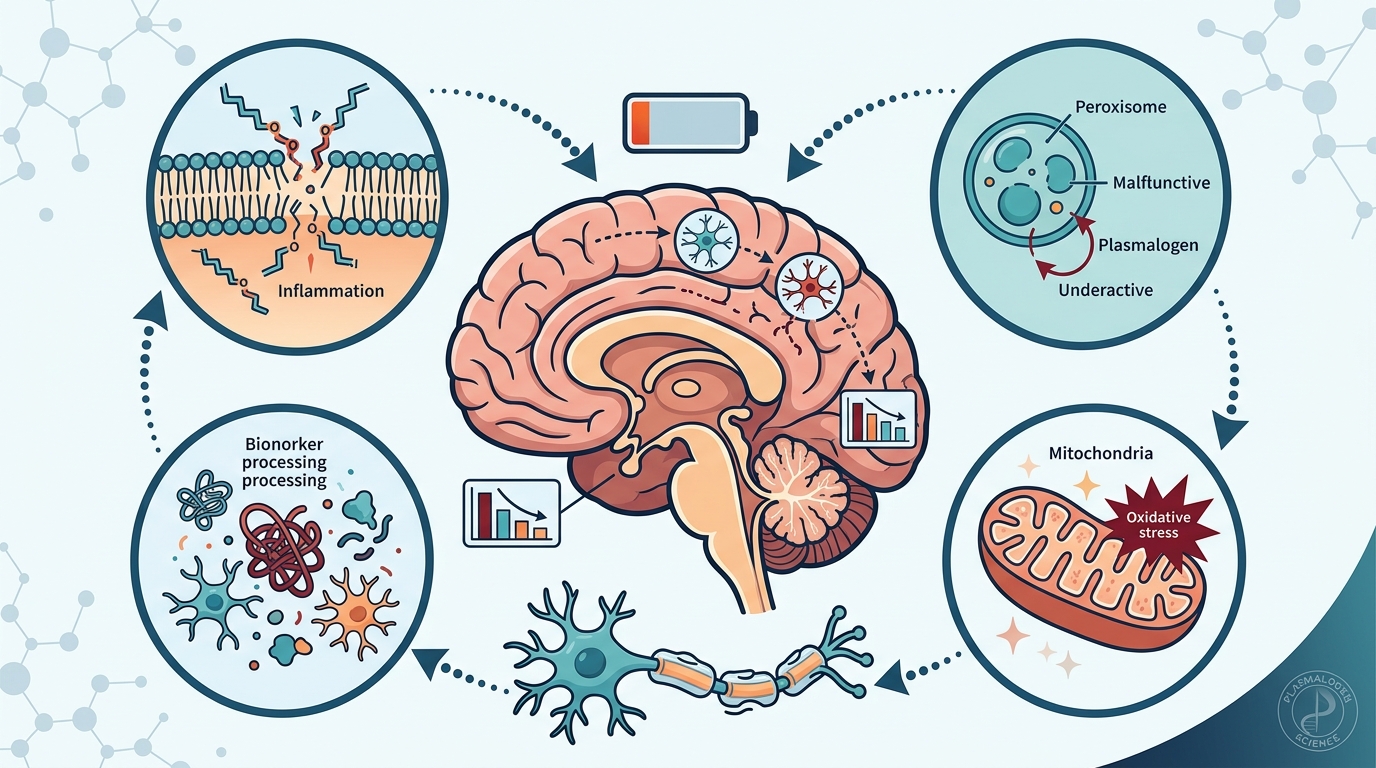
Plasmalogens are synthesized in the peroxisome, an organelle responsible for fatty acid β-oxidation, ROS detoxification, and ether lipid assembly. The first two enzymatic steps — catalyzed by glyceronephosphate O-acyltransferase (GNPAT) and alkylglycerone phosphate synthase (AGPS) — occur exclusively in this organelle before intermediates migrate to the endoplasmic reticulum for completion.
Peroxisomal function declines with age. As peroxisomes become less efficient, plasmalogen biosynthesis slows, oxidative stress management falters, and the downstream consequences cascade into neuronal membranes. This creates a scenario in which the brain progressively loses the ability to replenish the very lipids it needs most for membrane maintenance and antioxidant defense.
Dysregulation of plasmalogen homeostasis has additionally been shown to impair cholesterol biosynthesis, adding another layer of metabolic disruption relevant to neurodegeneration. Aging-related peroxisomal dysfunction may therefore represent a root-cause bottleneck that precedes and potentiates neurodegenerative pathology.
Pathway 5 — Dopaminergic Vulnerability in Parkinson's Disease
While much of the plasmalogen-neurodegeneration literature has historically focused on Alzheimer's disease, a growing body of evidence now implicates plasmalogen depletion in PD-specific pathology. Plasmalogen loss has been reported in patients with Parkinson's disease, and the striatal dopaminergic system appears especially sensitive to this deficit.
In animal models using the neurotoxin MPTP — which selectively destroys dopaminergic neurons — pretreatment with a plasmalogen precursor at doses of 10 and 50 mg/kg prevented MPTP-induced striatal dopamine loss. In a separate study using parkinsonian monkeys, plasmalogen precursor treatment at 50 mg/kg significantly reduced levodopa-induced dyskinesia (LID), and notably elicited a beneficial response earlier than DHA treatment alone at 100 mg/kg. These findings suggest that the plasmalogen backbone itself — not merely its DHA cargo — confers distinct neuroprotective benefits in the dopaminergic system.
Erythrocyte and Serum Biomarkers — Measuring the Deficit
One of the most practical aspects of plasmalogen science is measurability. Researchers have repeatedly demonstrated that the relative composition of ethanolamine plasmalogen (PlsEtn) in erythrocyte membranes decreases in patients with AD, PD, and cardiovascular disease compared to age-matched controls. This makes erythrocyte plasmalogen levels a potential peripheral biomarker accessible through a simple blood draw.
Serum-based lipidomic panels now allow clinicians and researchers to quantify DHA-PlsEtn and total PlsEtn ratios alongside other phospholipid species. The clinical significance of these measurements lies in their potential for early detection: plasmalogen depletion may appear years before clinical symptoms, offering a window for preventive intervention.
Peripheral ethanolamine plasmalogen deficiency has been described as a logical causative factor in Alzheimer's disease and dementia, based on population-level analyses published in the Journal of Lipid Research as early as 2007. Subsequent lipidomic studies of cerebrospinal fluid, frontal cortex grey matter, and white matter in control, MCI, and AD subjects have further validated the association.
From Bench to Bedside — Supplementation Trials
The transition from observational correlation to interventional evidence has accelerated in recent years. Key studies include:
- Randomized controlled trial in MCI and mild AD: A 24-week, multicenter, randomized, double-blind, placebo-controlled trial enrolled 178 MCI patients and 98 mild AD patients. Participants received scallop-derived purified plasmalogens and showed significant improvement in cognitive function and other clinical symptoms, with concurrent elevation of blood plasmalogen levels. No adverse events were reported.
- Open-label studies in moderate-to-severe AD and PD: Separate 12-week (moderate AD, n = 57; severe AD, n = 18) and 24-week (PD, n = 10) open-label studies also demonstrated cognitive and clinical improvements associated with oral plasmalogen supplementation.
- DHA-AAG escalating-dose trial: An investigational trial in 22 cognitively impaired persons evaluated escalating oral doses of synthetic DHA-AAG plasmalogen precursors from 900 to 3,600 mg/day over four months. DHA plasmalogen levels increased dose-dependently, and twelve of eighteen participants who completed the study reported improved overall health.
While these results are promising, larger, longer-duration randomized controlled trials are needed before definitive clinical recommendations can be made. The existing evidence, however, strongly supports the biological plausibility of plasmalogen restoration as a therapeutic strategy.
Key Takeaways
- Plasmalogens sit at the intersection of five neurodegenerative pathways: membrane integrity, protein aggregate toxicity, antioxidant defense, peroxisomal biosynthesis, and dopaminergic protection.
- Depletion is measurable: Erythrocyte and serum plasmalogen levels serve as accessible biomarkers that may flag risk before clinical symptoms emerge.
- The vinyl-ether bond is uniquely protective: No other membrane lipid offers the same sacrificial ROS-scavenging capability embedded directly in the phospholipid bilayer.
- Animal and early human trials show promise: Both scallop-derived plasmalogens and synthetic DHA-AAG precursors have demonstrated cognitive and neuroprotective benefits in controlled settings.
- Peroxisomal health is upstream of everything: Supporting peroxisome function through lifestyle and nutritional strategies may help sustain endogenous plasmalogen production as the body ages.
Frequently Asked Questions
Are low plasmalogen levels a cause or consequence of Alzheimer's disease?
Evidence points in both directions. Plasmalogen deficiency has been documented in early-stage AD subjects and in animal models before significant plaque formation, suggesting it may be a contributing cause. However, oxidative stress from disease progression also degrades plasmalogens, creating a self-reinforcing cycle. The current scientific consensus treats the relationship as bidirectional.
Can plasmalogen supplements help with Parkinson's disease symptoms?
Preliminary evidence from a 24-week open-label study in 10 PD patients showed improvement in clinical symptoms with oral plasmalogen supplementation. In animal models, plasmalogen precursors have also prevented dopamine loss and reduced levodopa-induced dyskinesia. Larger controlled trials are needed to confirm these findings.
How can I measure my plasmalogen levels?
Plasmalogen levels can be measured through lipidomic analysis of a blood sample. Both erythrocyte membrane composition and serum phospholipid panels can quantify ethanolamine plasmalogen (PlsEtn) levels. Several specialized laboratories now offer these tests, though they are not yet part of standard clinical panels.
What foods contain plasmalogens?
Plasmalogens are found in marine sources such as scallops, mussels, krill, and shark liver oil. They are also present in animal organ meats. However, dietary plasmalogens are partially degraded during digestion, which is why researchers have also explored synthetic plasmalogen precursors (such as DHA-AAG) that can be converted into plasmalogens after absorption.
Why do plasmalogen levels decline with age?
Plasmalogen biosynthesis depends on peroxisome function, which declines with age. Additionally, cumulative oxidative stress consumes plasmalogens faster than aging cells can replace them. Dietary insufficiencies and chronic inflammation further exacerbate the decline, creating a progressive deficit that accelerates after midlife.