

Neurodegenerative diseases strip away cognition, motor control, and independence — and emerging lipid science points to a common biochemical thread running through many of them: the depletion of plasmalogens. This ultimate guide explores the cascading consequences of plasmalogen loss in the brain, the evidence from peer-reviewed research, and what it all means for future prevention and therapy.
One in Five: The Scale of Plasmalogens in Human Biology
Plasmalogens are not minor biochemical curiosities. Approximately one in five phospholipids in the human body are plasmalogens, and they are especially concentrated in the brain, heart, and immune cells. This makes them one of the most prevalent lipid classes in neural tissue, where they serve structural, signaling, and protective roles simultaneously.
Their defining molecular feature — a vinyl-ether bond at the sn-1 position of the glycerol backbone — gives them chemical and biophysical properties distinct from conventional ester-linked phospholipids. This bond allows plasmalogens to modulate membrane fluidity, organize lipid rafts critical for receptor signaling, and serve as sacrificial scavengers of reactive oxygen species (ROS).
The Vicious Cycle Between Plasmalogen Loss and Neurodegeneration
One of the most important concepts in modern plasmalogen research is the idea of a self-reinforcing feedback loop. Researchers analyzing the evidence through Bradford Hill causal criteria have concluded that plasmalogen deficiency increases susceptibility to neurodegeneration. Because Alzheimer's disease is multifactorial, other risk factors trigger the disease process in a brain already made vulnerable by low plasmalogen levels. Crucially, the disease process itself further depletes plasmalogens, initiating what scientists describe as a vicious cycle.
This bidirectional relationship means that plasmalogen loss is neither purely a cause nor merely a consequence of neurodegeneration — it is both, accelerating decline once the cycle begins. Understanding this feedback loop reframes plasmalogen restoration from a speculative idea to a logical therapeutic target.
Alzheimer's Disease — Membrane Collapse and Amyloid Vulnerability
Alzheimer's disease (AD) is the most common form of dementia, and the connection between AD and plasmalogen depletion has been documented across multiple independent research groups since the late 1990s. Studies have found that the level of plasmenyl ethanolamine (PlsEtn) — the most abundant plasmalogen subtype in the brain — can be significantly reduced in both the brain tissue and serum of AD patients, with the magnitude of reduction correlating with disease severity.
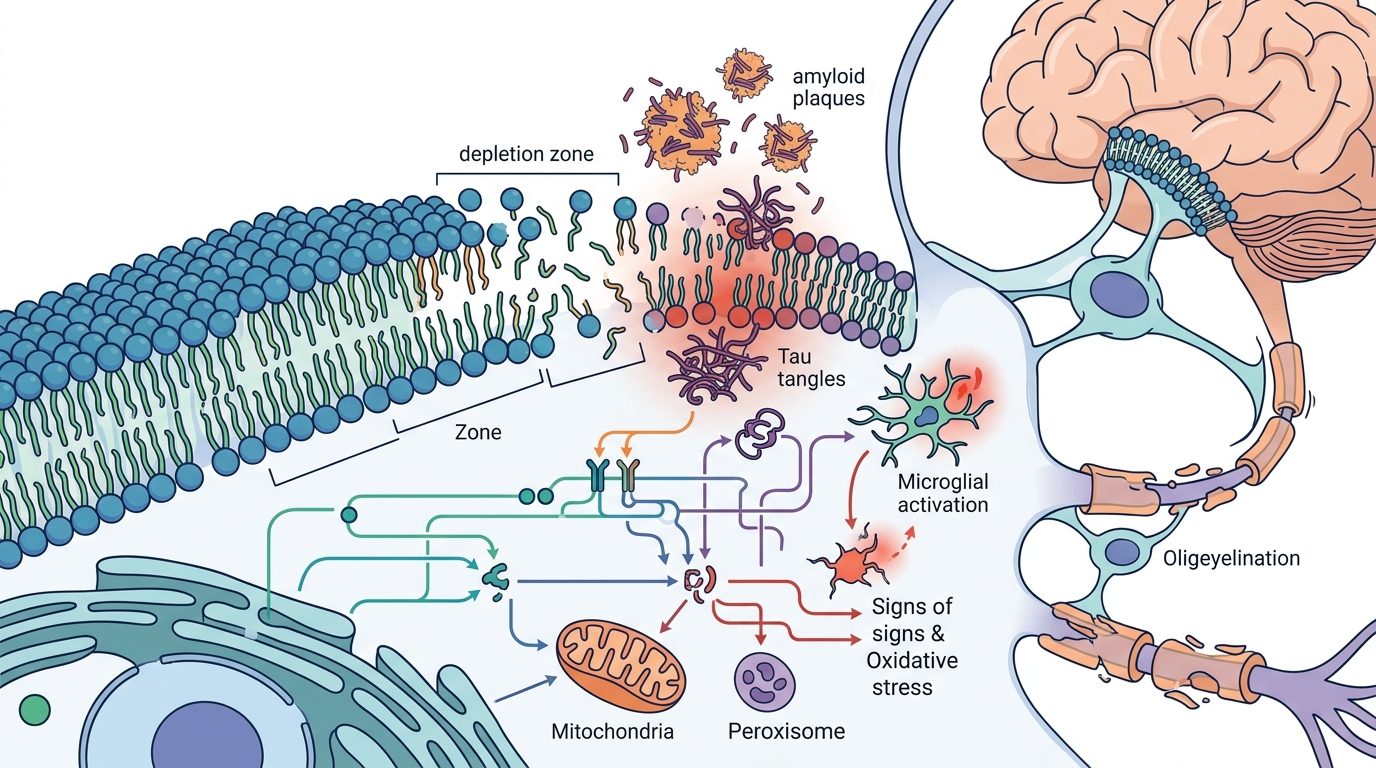
Why does this matter mechanistically? Plasmalogens play a critical role in brain health by supporting neuronal function, protecting against oxidative damage, and reducing neuroinflammation. They are also essential for maintaining synaptic integrity, enhancing neurotransmission, and preventing β-amyloid accumulation — three key factors in the progression of AD. When plasmalogen levels drop, the brain loses a frontline defense against the very pathologies that define Alzheimer's.
Plasmalogen deficiency in AD leads to disturbances in myelin structure, impaired synaptic neurotransmission and intracellular signaling, increased neuronal apoptosis, and heightened neuroinflammation. Each of these downstream effects further damages the cellular environment, compounding the original deficit.
Parkinson's Disease — Motor Decline and Ether-Lipid Deficits
Parkinson's disease (PD) is the second most common neurodegenerative disease after Alzheimer's. While dopaminergic therapy remains the standard treatment, it does not adequately address many nonmotor symptoms — including sleep disorders, depression, and cognitive decline — that severely impact quality of life.
Reduced plasmalogen levels have been documented in PD patients, and emerging research is exploring whether restoring these lipids could address symptom domains that current drugs miss. In one preliminary clinical report, ten PD patients received oral administration of scallop-derived purified ether phospholipids (1 mg/day) for 24 weeks, with clinical symptoms and blood biomarkers monitored throughout the trial period.
On the preclinical side, researchers have demonstrated advantages of using lipid nanoparticles (LNPs) to deliver plasmalogen in transgenic Parkinson's disease mouse models. Self-assembled plasmalogen-based LNPs showed significant positive effects on motor impairment, opening a novel delivery avenue for future therapeutics.
Beyond AD and PD: Multiple Sclerosis, RCDP, and Broader Implications
The link between plasmalogen deficiency and neurological damage extends well beyond the two most common neurodegenerative diseases. Reduced plasmalogen levels have been documented in multiple sclerosis (MS), schizophrenia, and the genetic peroxisomal disorder rhizomelic chondrodysplasia punctata (RCDP).
RCDP is caused by mutations in peroxisomal genes essential for plasmalogen biosynthesis. Because peroxisomes are the organelles where the first steps of plasmalogen synthesis occur, genetic defects in enzymes like GNPAT (RCDP type 2) or AGPS (RCDP type 3) result in severe plasmalogen impairment. The neurological consequences — myelination deficits, cerebellar atrophy, and loss of Purkinje cells — provide some of the strongest evidence that plasmalogen deficiency directly damages the nervous system.
When peroxisomes do not function properly, the body struggles to produce plasmalogens, leading to muscle weakness, developmental delays, and cognitive decline. The brain and nervous system depend highly on plasmalogens to keep neurons healthy and ensure smooth cell-to-cell communication.
Oxidative Stress, Myelin Integrity, and Synaptic Breakdown
The aging brain is characterized by increased oxidative stress, mitochondrial dysfunction, and chronic neuroinflammation — all of which contribute to cognitive decline and elevated risk of neurodegenerative disease. Plasmalogens sit at the intersection of all three pathways.
Their vinyl-ether bond acts as a preferential target for reactive oxygen species, effectively scavenging ROS before they can damage adjacent membrane lipids or proteins. This antioxidant mechanism is self-sacrificial: the plasmalogen molecule is consumed in the process, which is why sustained biosynthesis through healthy peroxisomal function is essential.
Plasmalogens also modulate membrane trafficking, cell signaling, transporter functions, and the storage of polyunsaturated fatty acids (PUFAs) — particularly DHA and EPA — that are critical for synaptic plasticity. A deficit in plasmenyl ethanolamine leads to disturbances in myelin structure, impaired synaptic neurotransmission and intracellular signaling, and increased neuronal apoptosis. In macrophages, plasmenyl ethanolamine influences inflammatory signal transduction by controlling the number and size of lipid rafts, adding yet another layer to its neuroprotective repertoire.
What Animal Studies Reveal About Plasmalogen Restoration
A landmark 2022 study published in Frontiers in Molecular Biosciences administered plasmalogens extracted from ascidian (Halocynthia roretzi) to aged female mice for two months. The results were striking: plasmalogen-fed mice exhibited better cognitive performance, and transmission electron microscopy data showed that supplementation alleviated age-associated hippocampal synaptic loss while promoting synaptogenesis and synaptic vesicle formation.
The researchers concluded that plasmalogens improved cognition and memory by reducing neuroinflammation and supporting synaptogenesis and neurogenesis in aged mice, suggesting that plasmalogen administration may serve as a potential intervention strategy for halting neurodegeneration and promoting neuroregeneration.
More recent animal work reinforces these findings. A 2025 study using a mouse model of age-related cognitive decline found that plasmalogens improved spatial memory by approximately 44% and boosted synaptic proteins such as PSD-95 in the hippocampus while reducing markers of brain inflammation.
Early Human Evidence: Scallop-Derived Ether Phospholipids in PD Patients
While animal data are encouraging, human trials remain in early stages. The preliminary Parkinson's study mentioned earlier — using scallop-derived ether phospholipids — represents one of the first attempts to directly test plasmalogen supplementation in a clinical neurodegenerative population. Patients were monitored at 0, 4, 12, 24, and 28 weeks for both blood plasmalogen levels and clinical symptom changes.
These early-stage findings are not yet definitive, but they establish feasibility and safety for oral ether-phospholipid delivery — a necessary foundation for larger randomized controlled trials. Given that effective treatments for age-related cognitive impairment remain elusive, the plasmalogen supplementation approach fills an important gap in the therapeutic landscape.
The Gut–Brain Axis: An Unexpected Plasmalogen Pathway
An intriguing emerging area involves the gut–brain connection. Some studies have shown that dietary plasmalogens affect the composition of gut microorganisms. Since the relationship between gut microbiota and brain function is increasingly recognized as a factor in neurodegeneration, researchers have speculated that plasmalogens may exert some of their cognitive benefits indirectly through this axis.
This adds a systems-biology dimension to plasmalogen research: rather than acting solely at the level of the neuronal membrane, dietary plasmalogens may influence brain health through immune modulation, metabolite signaling, and microbiome remodeling in the gastrointestinal tract. Future studies will need to disentangle direct membrane effects from gut-mediated mechanisms.
Key Takeaways
- Plasmalogens are abundant in the brain — roughly 1 in 5 phospholipids — and their levels decline with age and in neurodegenerative disease.
- A vicious cycle exists: plasmalogen deficiency increases vulnerability to neurodegeneration, and the disease process further depletes plasmalogens.
- In Alzheimer's disease, plasmalogen loss correlates with disease severity and compromises amyloid clearance, synaptic integrity, and myelin structure.
- In Parkinson's disease, preliminary human trials with scallop-derived ether phospholipids have begun exploring symptomatic benefits beyond dopaminergic therapy.
- Animal studies show measurable improvements — up to 44% gains in spatial memory — from plasmalogen supplementation, alongside reduced neuroinflammation and enhanced synaptogenesis.
- Genetic disorders like RCDP demonstrate that severe plasmalogen deficiency directly causes neurological damage, strengthening the causal argument.
- Gut–brain axis effects represent a new frontier in understanding how dietary plasmalogens reach and benefit the brain.
Frequently Asked Questions
Are low plasmalogen levels a cause or a consequence of Alzheimer's disease?
Current evidence suggests both. Researchers believe that plasmalogen deficiency increases the brain's susceptibility to neurodegeneration, while the Alzheimer's disease process in turn further depletes plasmalogens, creating a self-reinforcing vicious cycle. This perspective has been evaluated against Bradford Hill causal criteria in peer-reviewed literature.
How are plasmalogens connected to Parkinson's disease specifically?
Reduced plasmalogen levels have been documented in Parkinson's patients. Preliminary clinical studies have tested oral administration of scallop-derived ether phospholipids in PD patients over 24 weeks, monitoring nonmotor symptoms that standard dopaminergic therapy does not adequately address. Preclinical studies have also shown that plasmalogen-loaded lipid nanoparticles improved motor impairment in transgenic PD mouse models.
What role do peroxisomes play in plasmalogen production and brain health?
Peroxisomes are the cellular organelles where the initial steps of plasmalogen biosynthesis occur. When peroxisomal genes are mutated — as in rhizomelic chondrodysplasia punctata (RCDP) — the body cannot produce adequate plasmalogens, leading to severe neurological consequences including myelination deficits and cerebellar atrophy. This genetic evidence strongly supports a causal link between plasmalogen deficiency and neurodegeneration.
Can plasmalogen supplements improve cognitive function?
Animal studies have demonstrated measurable cognitive benefits. For example, one study found approximately 44% improvement in spatial memory in aged mice receiving plasmalogen supplementation, along with increased synaptic protein expression and reduced neuroinflammation. Human trials remain in early stages but have established the feasibility and safety of oral ether-phospholipid supplementation.
How do plasmalogens protect neurons from oxidative stress?
Plasmalogens contain a vinyl-ether bond that acts as a preferential target for reactive oxygen species (ROS). By scavenging ROS before they can damage neighboring membrane lipids and proteins, plasmalogens serve as self-sacrificial antioxidants. This mechanism is especially important in the brain, which has high metabolic activity and is particularly vulnerable to oxidative damage.