

Plasmalogens are everywhere in your nervous system, yet most health discussions skip over them entirely. Below, Plasmalogen Science breaks down five distinct mechanisms through which these vinyl-ether phospholipids keep neurons firing, membranes flexible, and myelin intact.
Role 1 — Membrane Architecture and Fluidity
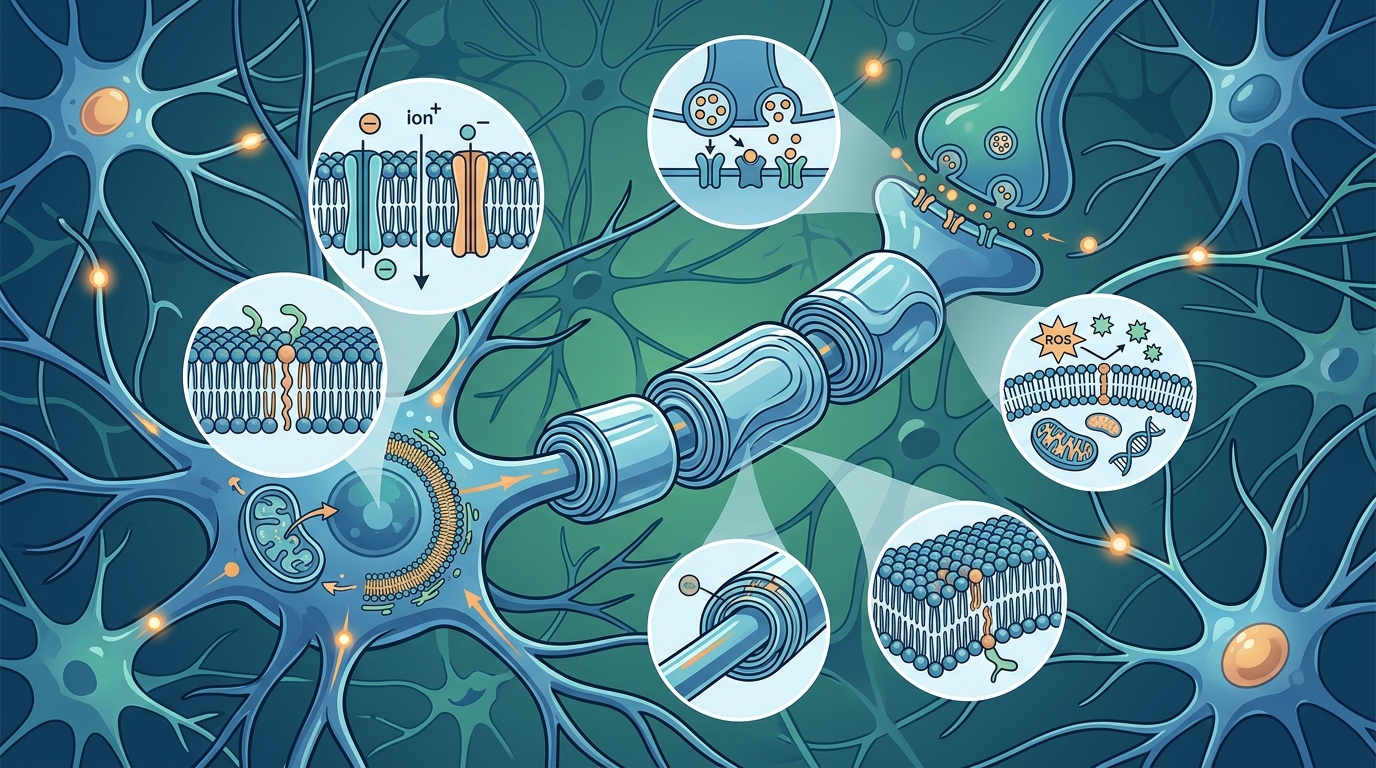
Every neuron in your brain is wrapped in a lipid bilayer whose physical properties dictate how well ion channels open, receptors bind ligands, and signals propagate. Plasmalogens are not minor constituents of that bilayer. They make up roughly one-fifth of all phospholipids in human cell membranes, with an even higher proportion concentrated in brain tissue.
What sets plasmalogens apart from ordinary phospholipids is the vinyl-ether bond at the sn-1 position of the glycerol backbone. This bond causes the two hydrocarbon chains to pack more tightly at the membrane–water interface while allowing greater flexibility deeper in the bilayer. The net effect is a membrane that is simultaneously more ordered at its surface and more fluid in its core — exactly the combination neurons need for rapid signal transduction.
Research published in Brain Research Bulletin explains that plasmalogens change the curvature, fluidity, rigidity, thickness, and lateral pressure of planar cell membranes and also modulate the activity of integral membrane proteins by interacting with them. In other words, the presence or absence of plasmalogens reshapes the physical environment in which every membrane-bound protein operates.
Role 2 — Myelin Sheath Composition
Myelin is the fatty insulation that wraps around axons and allows electrical impulses to jump from node to node at high speed. Without adequate myelin, neural communication slows, and white-matter integrity deteriorates.
Plasmalogens are not merely present in myelin — they dominate it. Ethanolamine plasmalogen (PlsEtn) accounts for over 50 percent of the total ethanolamine phosphoglycerides in gray matter and over 85 percent of those in myelin. In some analyses, plasmalogens can account for up to 70 percent of total phospholipids in the myelin sheath. This extreme enrichment is not accidental; it reflects the biophysical demands of a structure that must remain stable, tightly packed, and resistant to oxidative degradation over decades of use.
When plasmalogen levels fall, myelin suffers. In rhizomelic chondrodysplasia punctata (RCDP), a rare peroxisomal disorder that abolishes plasmalogen biosynthesis, myelination deficits, enlarged ventricles, and cerebellar atrophy are among the main neurological abnormalities. This genetic condition offers a stark illustration of what happens when the body cannot manufacture enough plasmalogens to build and maintain myelin.
Role 3 — Oxidative-Stress Shield
The brain consumes roughly 20 percent of the body's oxygen, generating a constant stream of reactive oxygen species (ROS). Neurons therefore need antioxidant mechanisms embedded directly in their membranes — not just circulating in plasma.
The vinyl-ether bond that defines plasmalogens is preferentially attacked by ROS, which means the plasmalogen molecule itself is sacrificed before other membrane lipids, proteins, or DNA can be damaged. This sacrificial oxidation is a form of built-in antioxidant defense at the lipid-bilayer level.
Plasmalogens bolster membrane stability, modulate mitochondrial efficiency, and mitigate inflammation through reactive oxygen species scavenging. Because the oxidized plasmalogen can be replaced through continuous biosynthesis in peroxisomes, the system functions like a renewable shield — as long as peroxisomal activity remains healthy.
Role 4 — Synaptic Vesicle Fusion and Neurotransmission
For a neurotransmitter to be released, a synaptic vesicle must fuse with the presynaptic membrane. That fusion event depends critically on membrane curvature, and plasmalogens are one of the principal lipids that create the negative curvature required at the fusion site.
Plasmalogens maintain membrane fluidity, support synaptic vesicle fusion — the mechanism by which neurotransmitters are released — protect myelin integrity, and modulate inflammatory signaling. When plasmalogen levels in presynaptic terminals decline, vesicle fusion becomes less efficient, and neurotransmitter release slows.
A 2022 study in Frontiers in Molecular Biosciences demonstrated that plasmalogen administration improved cognition and memory in aged mice by supporting synaptogenesis and neurogenesis. The glycerol backbone of plasmalogens is also frequently bonded to polyunsaturated fatty acids such as DHA and arachidonic acid, reinforcing plasmalogens' role as reservoirs for signaling lipids that modulate both pro-inflammatory and anti-inflammatory cascades.
Role 5 — Neuroinflammation Regulation
Chronic, low-grade neuroinflammation is a hallmark of brain aging and a driver of neurodegenerative disease. Microglia — the resident immune cells of the central nervous system — are key mediators of that inflammatory response.
Plasmalogen supplementation in aged mice has been shown to reduce microglia-mediated neuroinflammation while simultaneously promoting neuroregeneration. The mechanism likely involves both the antioxidant sacrificial action of the vinyl-ether bond (reducing the oxidative triggers that activate microglia) and the release of DHA and other omega-3 fatty acids from the sn-2 position, which feed into pro-resolving lipid mediator pathways.
Data from the Rush University Memory and Aging Project further support this connection at the epidemiological level, revealing strong correlations between higher plasmalogen levels and reduced dementia risk — a relationship consistent with lower chronic neuroinflammatory burden.
What Happens When Plasmalogens Decline
Plasmalogen levels do not remain constant throughout life. They peak in mid-adulthood and then decline with age — a trajectory that accelerates in certain disease states.
Alzheimer's Disease
Research published in the Journal of Neurochemistry demonstrated a dramatic decrease in plasmalogen content — up to 40 mol% of total plasmalogen — in white matter at a very early stage of Alzheimer's disease. Critically, the decline in white matter preceded changes in gray matter, suggesting that white-matter plasmalogen loss may be an early event in disease progression rather than a late consequence.
A longitudinal study presented at the Alzheimer's Association International Conference found that a decrease in plasmalogen index from baseline was associated with higher odds of converting from normal cognition to mild cognitive impairment or Alzheimer's, while a higher baseline plasmalogen index was protective.
Multiple Sclerosis
Because plasmalogens are a fundamental component of the myelin sheath, their deficiency has particular relevance to MS, a disease characterized by demyelination and chronic inflammation. Studies suggest that low plasmalogen levels correlate with disease severity, and that restoring plasmalogen levels may promote remyelination and reduce inflammation.
Parkinson's Disease
In Parkinson's disease, plasmalogen levels are significantly reduced, and oxidative stress in dopaminergic neurons is a central pathological feature. Supplementation research suggests plasmalogens may support mitochondrial function and reduce neuroinflammation in this context.
Key Takeaways
- Plasmalogens are structural essentials, not optional extras. They comprise up to 85 percent of ethanolamine phospholipids in myelin and roughly 20 percent of total membrane phospholipids body-wide.
- The vinyl-ether bond is the key differentiator. It simultaneously tunes membrane biophysics and acts as a sacrificial antioxidant.
- Synaptic function depends on plasmalogens. Vesicle fusion, neurotransmitter release, and receptor signaling all require plasmalogen-enriched membranes.
- Decline is measurable and begins before symptoms. Blood and tissue plasmalogen levels drop with age and drop faster in Alzheimer's, Parkinson's, and MS.
- Peroxisomes are the bottleneck. Plasmalogen biosynthesis begins in peroxisomes, so peroxisomal health is upstream of every role listed above.
Frequently Asked Questions
What are plasmalogens?
Plasmalogens are a subclass of phospholipids distinguished by a vinyl-ether bond at the sn-1 position of the glycerol backbone. They are found in virtually every human tissue but are most concentrated in the brain, heart, and immune cells.
Why are plasmalogens important for the brain?
The brain is one of the most lipid-rich organs, and plasmalogens perform multiple roles there: maintaining membrane fluidity, enabling synaptic vesicle fusion, shielding neurons from oxidative stress, composing the majority of myelin phospholipids, and regulating neuroinflammation.
Do plasmalogen levels decline with age?
Yes. Multiple independent studies have documented age-related declines in circulating and tissue plasmalogens. The decline is more pronounced and begins earlier in individuals who go on to develop Alzheimer's disease or other dementias.
How are plasmalogens connected to myelin?
Plasmalogens — especially ethanolamine plasmalogens — make up the largest fraction of phospholipids in the myelin sheath. When plasmalogen synthesis is impaired, as in RCDP, severe myelination deficits result. In MS, plasmalogen depletion correlates with disease severity and demyelination.
Where are plasmalogens made in the body?
Plasmalogen biosynthesis starts in peroxisomes, small organelles found in nearly every cell. The initial steps — catalyzed by enzymes such as GNPAT and AGPS — occur exclusively in peroxisomes, after which intermediates move to the endoplasmic reticulum for completion.
Can you measure plasmalogen levels?
Yes. Lipidomics platforms using liquid chromatography–mass spectrometry (LC-MS) or electrospray ionization mass spectrometry (ESI-MS) can quantify plasmalogen species in blood or tissue samples. Blood-based plasmalogen panels are increasingly available as clinical biomarkers.