

Essential Nutrient Standards and Quality Benchmarks for Plasmalogen Biosynthesis
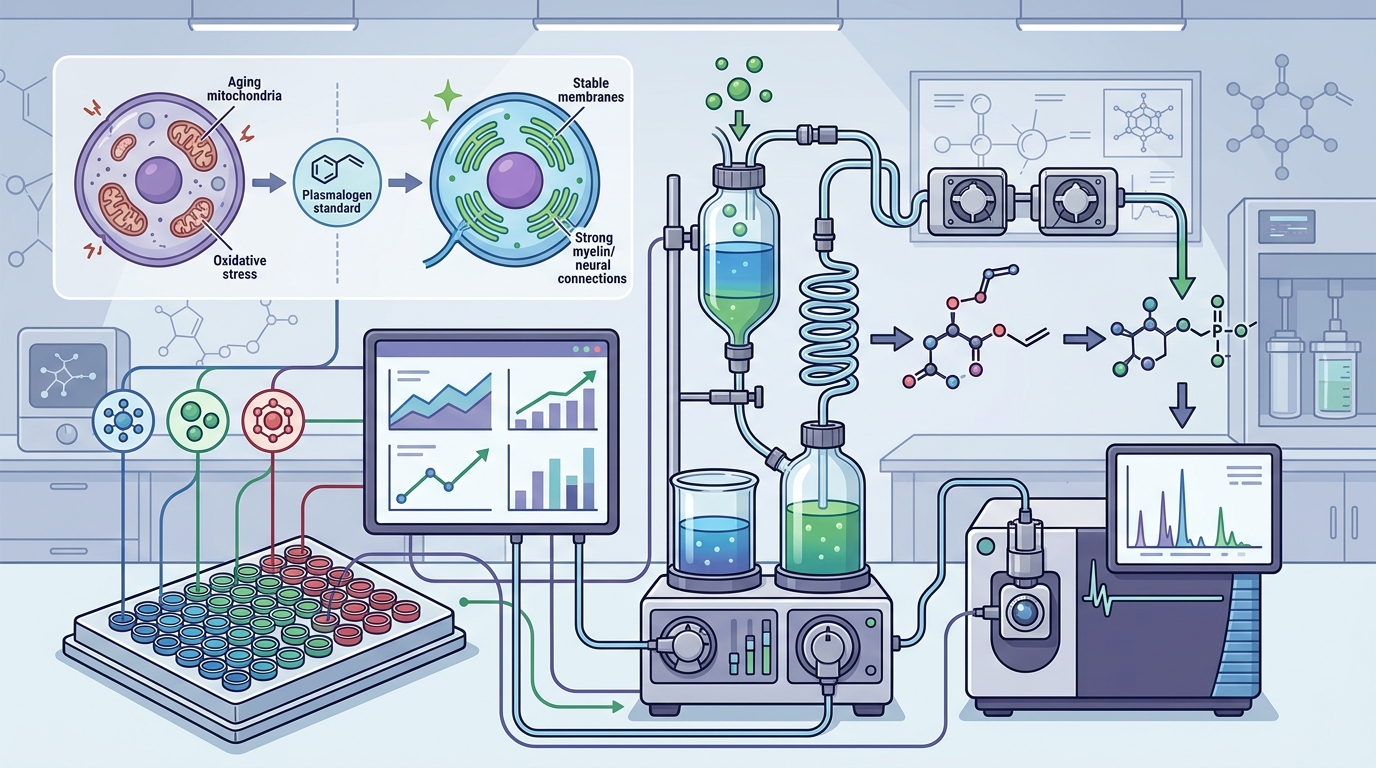
Plasmalogens are specialized ether phospholipids that serve as the primary antioxidant defense in cell membranes, particularly within the brain and heart. Recent research indicates that plasmalogen levels decline significantly with age, correlating with increased oxidative stress and neurodegenerative risk. According to a 2024 review in the journal Frontiers in Aging Neuroscience, maintaining optimal plasmalogen synthesis is critical for cellular resilience and healthy aging. This guide details the precise nutrient standards, biosynthetic pathways, and quality benchmarks required to support this vital biological process. (About This Project Plasmalogen)
What Are Plasmalogens?
Plasmalogens are a unique class of phospholipids characterized by a vinyl-ether linkage at the sn-1 position of the glycerol backbone. This chemical structure makes them highly susceptible to oxidation, allowing them to act as sacrificial antioxidants that protect other cellular components from free radical damage. Plasmalogens are essential for maintaining membrane fluidity, signal transduction, and mitochondrial function. (Home Plasmalogen Science)
Unlike standard phospholipids, plasmalogens are found in high concentrations in the myelin sheath of nerve cells and in cardiac tissue. Their presence is not merely structural but functional, influencing how cells communicate and respond to stress. Understanding their role is the first step in appreciating why specific nutrient standards are necessary for their production.
The Biosynthesis Pathway
The creation of plasmalogens is a complex, multi-step process that occurs in two distinct cellular organelles: the peroxisome and the endoplasmic reticulum. This dual-location requirement makes the pathway uniquely sensitive to cellular health and nutrient availability.
Step 1: Peroxisomal Initiation
The process begins in the peroxisome with the enzyme alkyl-dihydroxyacetone phosphate synthase (ALKH3DP). This enzyme catalyzes the formation of an ether bond between a fatty alcohol and dihydroxyacetone phosphate. This step is critical because it establishes the unique ether linkage that defines plasmalogens. Disruption in peroxisomal function can halt this process entirely, leading to severe deficiencies.
Step 2: Endoplasmic Reticulum Modification
The intermediate molecule is then transported to the endoplasmic reticulum. Here, the ether bond is elongated, and a phosphoethanolamine head group is attached. Finally, a dephosphorylation step removes the phosphate group, resulting in the final plasmalogen structure. This pathway requires a steady supply of specific fatty acids and cofactors to proceed efficiently.
Essential Nutrient Standards
To support the biosynthesis of plasmalogens, the body requires a precise array of nutrients. These nutrients act as cofactors for the enzymes involved in the pathway or as the raw materials for the lipid structure itself. Below are the essential nutrient standards for optimal plasmalogen synthesis.
1. Choline
Choline is a vital precursor for the synthesis of phosphoethanolamine, the head group attached to the plasmalogen backbone. Without adequate choline, the body cannot complete the final steps of plasmalogen formation. Dietary sources include eggs, liver, and soybeans. Clinical standards suggest that maintaining sufficient choline intake is non-negotiable for lipid metabolism.
2. Vitamin B12 (Cobalamin)
Vitamin B12 is a crucial cofactor for methionine synthase, an enzyme involved in the methylation cycle. Methylation is required to convert homocysteine to methionine, which is then converted to S-adenosylmethionine (SAMe). SAMe is the methyl donor for the alkyl-dihydroxyacetone phosphate synthase enzyme in the peroxisome. Deficiency in Vitamin B12 directly impairs the initiation of plasmalogen biosynthesis.
3. Folate (Vitamin B9)
Folate works in tandem with Vitamin B12 to support the methylation cycle. It helps regenerate methionine from homocysteine, ensuring a continuous supply of SAMe. Low folate levels can lead to elevated homocysteine, which is neurotoxic and further disrupts lipid metabolism. The standard for folate intake must be sufficient to support high-demand methylation processes.
4. Omega-3 Fatty Acids (DHA and EPA)
While plasmalogens themselves are the structural lipid, the fatty acids attached to them influence their function. Docosahexaenoic acid (DHA) is particularly important for brain health and is often found in conjunction with plasmalogens in neural tissues. Omega-3s also help reduce inflammation, creating a more favorable environment for plasmalogen synthesis and function.
5. Antioxidants (Vitamin E and C)
Because plasmalogens are sacrificial antioxidants, they are rapidly depleted during oxidative stress. Replenishing the body's antioxidant stores with Vitamin E and Vitamin C helps spare plasmalogens from unnecessary oxidation, allowing them to perform their protective roles more effectively. This indirect support is critical for maintaining plasmalogen levels over time.
Quality Benchmarks and Testing
Assessing plasmalogen status requires advanced health measurements beyond standard lipid panels. Standard cholesterol tests do not capture the nuanced levels of ether phospholipids. Advanced testing methods, such as mass spectrometry, are used to measure specific plasmalogen species in the blood.
Key Biomarkers
When evaluating plasmalogen levels, clinicians look at specific ratios and absolute concentrations. The ratio of plasmenylphosphoethanolamine to plasmanylphosphoethanolamine is often analyzed. Additionally, the levels of specific plasmalogen species, such as PE-P-18:0/20:4, are monitored for their correlation with cognitive health.
Interpreting Results
Low plasmalogen levels are associated with several health conditions, including Alzheimer's disease, cardiovascular disease, and metabolic syndrome. According to data from the National Institutes of Health, individuals with neurodegenerative disorders often show significantly reduced plasmalogen levels in their cerebrospinal fluid and blood. Tracking these levels over time provides a more accurate picture of cellular health than single-timepoint testing.
Impacts of Deficiency
When the body cannot produce sufficient plasmalogens, the consequences extend beyond simple lipid imbalance. The lack of this critical phospholipid affects multiple systems.
Neurological Decline
The brain is rich in plasmalogens, particularly in the myelin sheath. Deficiency can lead to demyelination, impaired nerve conduction, and increased oxidative damage to neurons. This is linked to cognitive decline, memory loss, and an increased risk of neurodegenerative diseases.
Cardiovascular Issues
Cardiac tissue also relies heavily on plasmalogens for membrane integrity and signal transduction. Low levels are associated with arrhythmias, heart failure, and increased susceptibility to ischemic injury. The heart's high energy demand makes it particularly vulnerable to the loss of plasmalogen-mediated antioxidant protection.
Skeletal and Muscular Effects
Plasmalogen deficient diseases often present with skeletal abnormalities, including shortened long bones and joint contractures. Muscle tone and motor function can be impaired due to the disruption of cellular energy metabolism and membrane signaling in muscle tissue. These effects highlight the systemic nature of plasmalogen importance.
Key Takeaways
- Plasmalogens are specialized ether phospholipids that serve as the primary antioxidant defense in cell membranes.
- Biosynthesis requires peroxisomal and endoplasmic reticulum coordination, making it sensitive to cellular health.
- Choline is essential for providing the phosphoethanolamine head group necessary for plasmalogen structure.
- Vitamin B12 and Folate support the methylation cycle, which provides the methyl groups required for plasmalogen initiation.
- Omega-3 fatty acids work synergistically with plasmalogens to reduce inflammation and support neural health.
- Advanced health measurements are required to accurately assess plasmalogen levels, as standard lipid panels are insufficient.
- Deficiency impacts include neurological decline, cardiovascular issues, and skeletal abnormalities.
Frequently Asked Questions
What is the primary function of plasmalogens?
Plasmalogens are specialized ether phospholipids that serve as the primary antioxidant defense in cell membranes, protecting cells from oxidative stress and maintaining membrane integrity.
How are plasmalogens synthesized in the body?
Plasmalogens are synthesized through a multi-step process that begins in the peroxisome with the formation of an ether bond and continues in the endoplasmic reticulum with the addition of a head group and final modifications.
Which nutrients are most critical for plasmalogen biosynthesis?
The most critical nutrients are choline, Vitamin B12, and folate. Choline provides the head group, while B12 and folate support the methylation cycle required for the initial steps of synthesis.
Can standard blood tests detect plasmalogen levels?
No, standard lipid panels do not measure plasmalogen levels. Advanced health measurements, such as mass spectrometry, are required to accurately assess specific plasmalogen species.
What are the signs of low plasmalogen levels?
Signs may include cognitive decline, increased oxidative stress, cardiovascular issues, and in severe cases, skeletal and muscular abnormalities. Low levels are also associated with accelerated aging.
How does aging affect plasmalogen levels?
Plasmalogen levels naturally decline with age. This decline is linked to increased oxidative stress and a higher risk of age-related diseases, making nutrient support increasingly important in later life.
Are there dietary sources of plasmalogens?
While the body synthesizes plasmalogens, dietary sources of the precursor nutrients are vital. Foods rich in choline, B vitamins, and omega-3 fatty acids support the body's ability to produce them.
Optimize Your Plasmalogen Levels
Understanding the essential nutrient standards for plasmalogen biosynthesis is the first step toward supporting your long-term health. By ensuring adequate intake of choline, B vitamins, and omega-3s, and by monitoring your levels through advanced testing, you can help maintain cellular resilience and healthy aging. For more information on how plasmalogens influence cellular energy and aging, explore our resources on Plasmalogens & Health. To learn about the science behind how the body produces these vital lipids, visit our guide on How the Body Produces Plasmalogens. You can also read about Advanced Health Measurements to understand how to track your progress. For more details on the role of plasmalogens in animals, check out Plasmalogens in Animals. To discuss your specific health goals, contact us today.