

Plasmalogen Unique Properties: Membrane, Oxidative, and Biosynthetic Roles
Plasmalogens possess unique structural and functional properties that distinguish them from standard ester phospholipids. Their defining vinyl ether bond provides exceptional antioxidant capacity, while their conical molecular shape actively shapes membrane curvature and lipid packing. Plasmalogen Science explores how these specialized ether lipids drive cellular resilience, neurological health, and metabolic stability.
Membrane Organization Properties
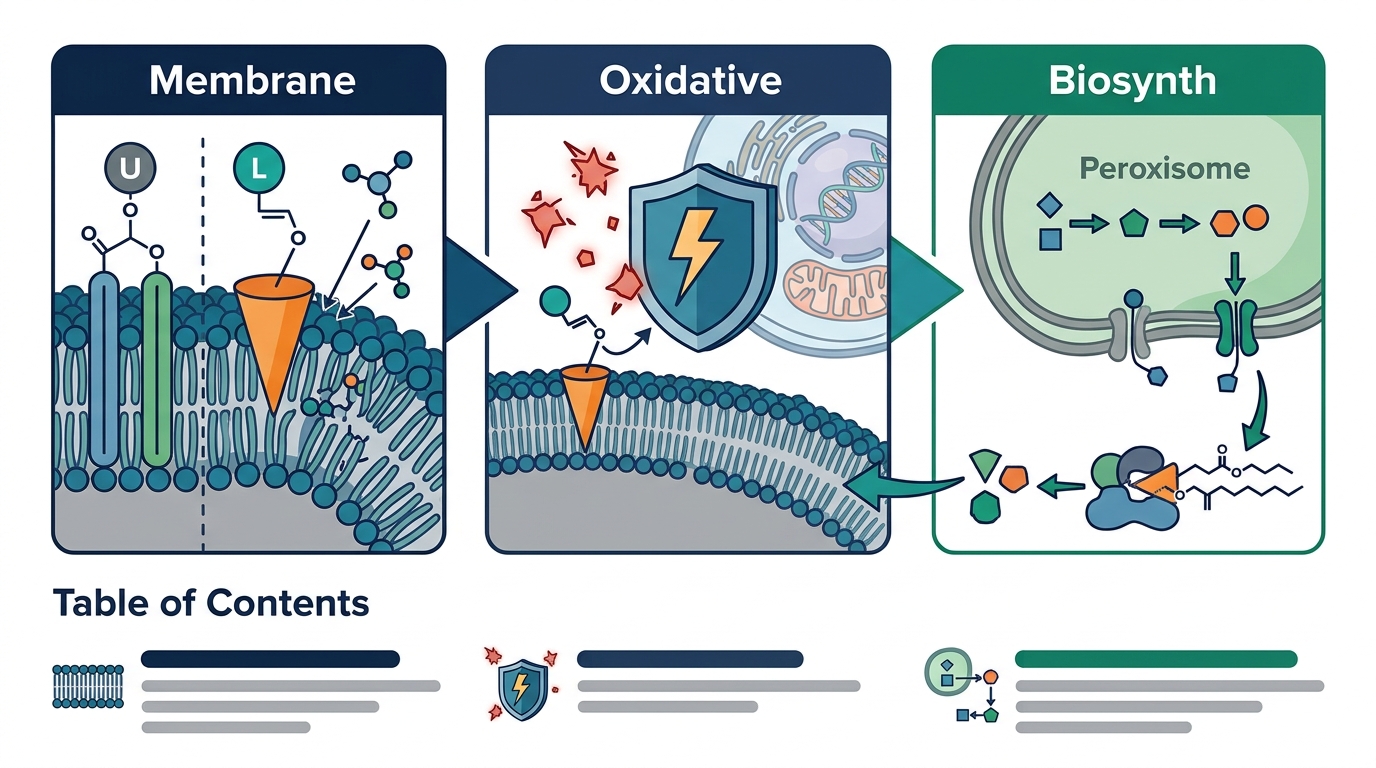
Plasmalogens are specialized ether phospholipids that fundamentally alter the physical architecture of cell membranes. Unlike standard phospholipids, which typically possess a cylindrical shape, plasmalogens exhibit a distinct conical geometry. This shape difference is driven by their unique vinyl ether bond at the sn-1 position of the glycerol backbone. The resulting molecular profile allows plasmalogens to pack differently within the lipid bilayer, creating localized areas of negative curvature.
Curvature and Lipid Packing
The conical shape of plasmalogens is critical for membrane dynamics. Research indicates that these lipids influence how membranes bend, fuse, and reorganize. This is particularly important in processes such as synaptic vesicle release, where membranes must rapidly change shape to release neurotransmitters. By modulating local membrane curvature, plasmalogens facilitate the formation of lipid rafts and specialized signaling domains. These domains concentrate specific proteins and receptors, enhancing the efficiency of cellular communication. according to Potential Role of
Fluidity and Flexibility
Plasmalogens also contribute to membrane fluidity and flexibility. The vinyl ether bond is more flexible than the ester bond found in standard phospholipids. This flexibility allows the lipid tails to move more freely, preventing the membrane from becoming too rigid. A flexible membrane is essential for proper protein function, nutrient transport, and cellular adaptation to stress. In tissues with high metabolic demands, such as the brain and heart, this flexibility supports the rapid signaling required for cognitive function and cardiac rhythm.
Oxidative Scavenging Function
One of the most significant unique properties of plasmalogens is their role as sacrificial antioxidants. The vinyl ether bond is highly susceptible to oxidation. When reactive oxygen species (ROS) attack the membrane, plasmalogens absorb the oxidative damage. This sacrificial mechanism protects other, more critical membrane components, such as polyunsaturated fatty acids, from lipid peroxidation. By acting as a buffer against oxidative stress, plasmalogens help maintain membrane integrity and prevent cellular damage.
Protection Against Lipid Peroxidation
Lipid peroxidation is a chain reaction that can severely damage cell membranes. When one lipid molecule is oxidized, it can trigger the oxidation of neighboring molecules. Plasmalogens interrupt this chain reaction by absorbing the initial oxidative hit. This protective function is vital in tissues exposed to high levels of metabolic activity and oxidative stress. For example, in the brain, where oxygen consumption is high, plasmalogens help shield neurons from oxidative damage that could otherwise lead to neurodegeneration.
Regulation of Inflammatory Signaling
Plasmalogens also play a role in regulating inflammatory responses. Oxidative stress is closely linked to inflammation, and the degradation of plasmalogens can produce bioactive lipid mediators. These mediators can influence immune cell activity and inflammatory signaling pathways. By modulating the balance between oxidative stress and inflammation, plasmalogens help maintain cellular homeostasis. This function is particularly relevant in chronic inflammatory conditions, where sustained oxidative stress can lead to tissue damage and disease progression.
Peroxisomal Biosynthesis
The production of plasmalogens is a complex process that primarily occurs within peroxisomes. These organelles are essential for ether lipid metabolism and play a critical role in cellular energy and detoxification. The biosynthesis of plasmalogens involves multiple enzymatic steps, beginning with the formation of a fatty alcohol intermediate. This intermediate is then converted into a plasmalogen through a series of reactions that occur in both peroxisomes and the endoplasmic reticulum.
The Role of Peroxisomes
Peroxisomes are membrane-bound organelles that contain enzymes involved in various metabolic processes. They are particularly important for the breakdown of very long-chain fatty acids and the synthesis of ether lipids. The peroxisomal environment provides the necessary conditions for the initial steps of plasmalogen biosynthesis. Disruptions in peroxisomal function can lead to plasmalogen deficiency, which has been associated with various neurological and metabolic disorders. Understanding the role of peroxisomes in plasmalogen production is crucial for developing therapeutic strategies to restore healthy plasmalogen levels.
Endoplasmic Reticulum Involvement
While peroxisomes initiate plasmalogen biosynthesis, the endoplasmic reticulum (ER) completes the process. The ER is responsible for the final steps of plasmalogen synthesis, including the addition of specific fatty acid chains. This collaboration between peroxisomes and the ER ensures that plasmalogens are produced in the correct quantities and with the appropriate fatty acid composition. The coordination between these two organelles highlights the complexity of plasmalogen biosynthesis and its importance in cellular health.
Comparison of Plasmalogen Properties
| Property | Plasmalogens | Standard Phospholipids |
|---|---|---|
| Chemical Bond | Vinyl ether bond | Ester bond |
| Molecular Shape | Conical | Cylindrical |
| Antioxidant Capacity | High (sacrificial) | Low |
| Membrane Curvature | Induces negative curvature | Neutral curvature |
| Biosynthesis Location | Peroxisomes and ER | ER |
Key Takeaways
- Plasmalogens are specialized ether phospholipids with a unique vinyl ether bond.
- Their conical shape influences membrane curvature and lipid packing.
- Plasmalogens act as sacrificial antioxidants, protecting membranes from oxidative stress.
- They play a role in regulating inflammatory signaling pathways.
- Peroxisomes are essential for the initial steps of plasmalogen biosynthesis.
- The endoplasmic reticulum completes plasmalogen synthesis.
- Plasmalogen levels are important biomarkers for cellular health and aging.
- Understanding plasmalogen properties is crucial for developing therapeutic strategies.
Frequently Asked Questions
What is the primary structural difference between plasmalogens and standard phospholipids?
The primary structural difference is the presence of a vinyl ether bond at the sn-1 position in plasmalogens, whereas standard phospholipids have an ester bond.
How do plasmalogens affect membrane curvature?
Plasmalogens have a conical shape that induces negative curvature in the lipid bilayer, facilitating processes like vesicle fusion.
Why are plasmalogens considered antioxidants?
Plasmalogens act as sacrificial antioxidants by absorbing oxidative damage from reactive oxygen species, protecting other membrane components.
Where are plasmalogens synthesized?
Plasmalogens are synthesized in peroxisomes and the endoplasmic reticulum.
What is the role of peroxisomes in plasmalogen biosynthesis?
Peroxisomes initiate plasmalogen biosynthesis by forming fatty alcohol intermediates, which are then processed in the endoplasmic reticulum.
How do plasmalogens relate to inflammation?
Plasmalogens regulate inflammatory signaling by modulating oxidative stress and producing bioactive lipid mediators.
Why are plasmalogens important in the brain?
Plasmalogens are highly concentrated in the brain, where they support synaptic function, membrane flexibility, and protection against oxidative stress.
Conclusion
Plasmalogens are far more than simple structural lipids. Their unique vinyl ether bond, conical shape, and sacr antioxidant properties make them critical players in cellular health. By shaping membrane organization, protecting against oxidative stress, and regulating inflammation, plasmalogens support the complex functions of the brain, heart, and immune system. Plasmalogen Science continues to explore these vital molecules, providing insights into their role in aging, disease, and cellular resilience. For a deeper understanding of how plasmalogens influence health, explore the comprehensive resources available on What Are Plasmalogens and Why Plasmalogens Matter.