

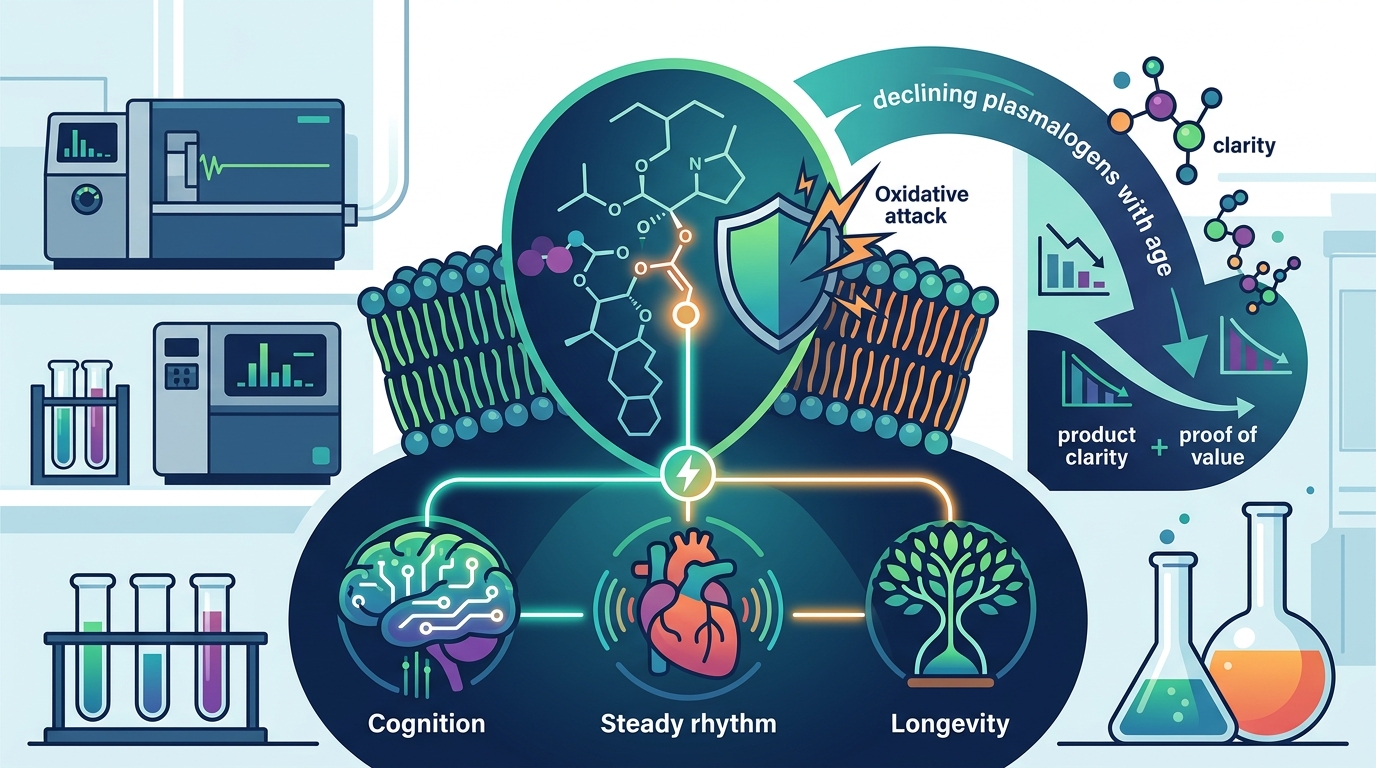
Your cells contain a phospholipid most people have never heard of—yet it accounts for up to one-fifth of every membrane in your body. It shields neurons from oxidative attack, keeps your heartbeat steady, and declines measurably with age. Its name is plasmalogen, and the science behind it is evolving fast.
Chemical Identity: What Makes a Plasmalogen Different
Plasmalogens belong to the glycerophospholipid family, but they carry a defining structural quirk that separates them from ordinary phospholipids. At the sn-1 position of the glycerol backbone, a standard phospholipid uses an ester bond to attach a fatty acid chain. A plasmalogen replaces that ester with a vinyl-ether bond—a carbon–oxygen double-bond linkage that gives the molecule its reactivity, its antioxidant capacity, and its name.
The two dominant subclasses are ethanolamine plasmalogens (PlsEtn) and choline plasmalogens (PlsCho). The ethanolamine form is heavily enriched in the brain and nervous system, whereas the choline form is more prominent in cardiac tissue. At the sn-2 position, plasmalogens typically carry polyunsaturated fatty acids such as docosahexaenoic acid (DHA) or arachidonic acid (AA), linking them directly to omega-3 and omega-6 metabolism.
Recent literature in the Journal of Lipid Research describes plasmalogens as structurally similar to phosphatidylcholine or phosphatidylethanolamine yet distinct because of that vinyl-ether linkage at Sn-1. This seemingly minor chemical difference produces far-reaching consequences for membrane physics, signaling, and cellular defense.
Tissue Distribution Across the Body
Plasmalogens are not distributed evenly. They concentrate where cellular demand for membrane integrity and signal speed is highest. Research consistently shows that plasmalogens account for approximately 15–20 mol% of total phospholipid mass in mammalian tissues, with marked enrichment in specific organs.
- Brain: Roughly 20% of brain lipid content consists of plasmalogens, with particularly high concentrations in myelin sheaths and synaptic membranes.
- Heart: Cardiac muscle membranes are rich in choline plasmalogens, supporting the electrical conduction system.
- Lungs: Surfactant-producing cells rely on plasmalogens for membrane flexibility.
- Immune cells: Neutrophils and macrophages contain substantial plasmalogen pools tied to inflammatory signaling.
- Eyes and kidneys: Both organs show elevated plasmalogen levels relative to skeletal muscle.
This uneven distribution is itself a clue: the organs most vulnerable to oxidative and metabolic stress are the ones that stockpile plasmalogens most aggressively.
How Peroxisomes Build Plasmalogens
Unlike most phospholipids, plasmalogen synthesis does not begin in the endoplasmic reticulum (ER). It starts in peroxisomes—small, single-membrane organelles best known for fatty acid oxidation and reactive oxygen species management.
The pathway begins when the peroxisomal enzyme GNPAT (glyceronephosphate O-acyltransferase) acylates dihydroxyacetone phosphate (DHAP). A second peroxisomal enzyme, AGPS (alkyldihydroxyacetone phosphate synthase), then swaps the acyl group for a long-chain fatty alcohol, creating the characteristic ether bond. The intermediate migrates to the endoplasmic reticulum, where additional enzymatic steps insert the sn-2 fatty acid and introduce the vinyl-ether double bond that converts an alkyl-ether precursor into a true plasmalogen.
This split-organelle pathway makes plasmalogen levels a sensitive readout of peroxisomal health. When peroxisomal function falters—whether from genetic mutations, aging, or chronic inflammation—plasmalogen output drops in parallel.
Five Biological Roles You Should Know
1. Membrane Architecture and Fluidity
The vinyl-ether bond causes the sn-1 chain to sit at a different angle compared with an ester-bonded chain. This alters how tightly lipids pack, increasing membrane fluidity and promoting the formation of lipid rafts—microdomains that organize receptor signaling. Roles for plasmalogens have been specifically identified in lipid rafts, myelin, and cholesterol metabolism.
2. Endogenous Antioxidant Shield
The vinyl-ether bond is preferentially attacked by reactive oxygen species (ROS), essentially sacrificing itself before ROS can reach polyunsaturated fatty acids or membrane proteins. This makes each plasmalogen molecule a built-in radical scavenger. The oxidative susceptibility of plasmalogens renders them protective under inflammatory or oxidative stress but also contributes to measurable depletion of the total plasmalogen pool over time.
3. Signaling Lipid Reservoir
When phospholipase A₂ cleaves the sn-2 fatty acid from a plasmalogen, it liberates arachidonic acid or DHA—precursors to eicosanoids, resolvins, and other signaling mediators. Plasmalogens therefore serve as a controlled-release depot for bioactive lipids involved in inflammation resolution and neuronal signaling.
4. Myelin Integrity
Myelin sheaths are among the most plasmalogen-dense structures in the body. Ethanolamine plasmalogens are fundamental to the structure and function of myelin, maintaining the insulation that allows rapid saltatory conduction along axons. When plasmalogen levels in white matter fall, demyelination follows—a pattern documented in both genetic models and neurodegenerative disease.
5. Cholesterol Homeostasis
Plasmalogens facilitate intracellular cholesterol transport and support reverse cholesterol transport pathways. This connects them to cardiovascular health, where high plasmalogen levels correlate positively with better lipid profiles and reduced risk of cardiovascular events.
Age-Related Decline and Disease Associations
Plasmalogen levels do not remain constant throughout life. They peak during early adulthood and begin a steady decline that accelerates after age 50. Chronic inflammation, oxidative stress, and reduced peroxisomal efficiency all contribute to this drop.
Alzheimer's Disease
Alzheimer's disease (AD) research provides some of the strongest evidence linking plasmalogen depletion to clinical outcomes. Studies using electrospray ionization mass spectrometry have demonstrated a dramatic decrease in plasmalogen content—up to 40 mol% of total plasmalogen—in white matter at very early stages of AD. In gray matter, plasmalogen deficiency correlates with disease severity, ranging from approximately 10 mol% depletion in very mild dementia to roughly 30 mol% in severe cases.
Parkinson's Disease
Preliminary clinical reports indicate that oral administration of ether phospholipids can improve blood plasmalogen levels and clinical symptoms in Parkinson's disease patients, though larger trials are still needed.
Cardiovascular Disease
Reduced circulating plasmalogens are associated with adverse lipid profiles and increased cardiovascular risk. Their role in cholesterol efflux and anti-inflammatory signaling positions them as both biomarkers and potential therapeutic targets in cardiometabolic disease.
Rare Peroxisomal Disorders
Genetic conditions such as Rhizomelic Chondrodysplasia Punctata (RCDP) result from mutations in plasmalogen synthesis enzymes—including GNPAT, AGPS, PEX7, FAR1, and PEX5. These disorders cause profound plasmalogen deficiency and severe developmental abnormalities, underscoring how critical these lipids are from birth.
Cancer, Schizophrenia, and Beyond
Reduced plasmalogen levels in circulation or in cell membranes have also been associated with cancer, kidney disease, liver disease, and schizophrenia. Research published in the Journal of Lipid Research in 2025 positions plasmalogens as both biomarkers and therapeutic targets across a wide spectrum of systemic and organ-specific diseases.
Measuring Plasmalogen Levels: Lipidomics in Practice
Advances in mass spectrometry—particularly shotgun lipidomics, liquid chromatography-tandem MS (LC-MS/MS), and high-resolution platforms such as Orbitrap analyzers—have made it possible to quantify individual plasmalogen molecular species in blood, tissue, and cerebrospinal fluid.
Circulating ethanolamine plasmalogen indices have been studied as potential blood-based biomarkers for Alzheimer's disease, with research showing correlations between specific PlsEtn species and cognition scores as well as cerebrospinal fluid tau levels. While clinical assays are not yet standardized for routine use, the field of plasmalogen measurement science is moving rapidly toward validated, accessible tests.
For researchers and clinicians, the key challenge is distinguishing true plasmalogens (vinyl-ether bonds) from plasmanyl lipids (alkyl-ether bonds) and diacyl phospholipids—species that can co-elute in chromatographic separation and produce confounding mass spectra without careful analytical design.
Emerging Approaches to Plasmalogen Restoration
Because plasmalogen deficiency is implicated in so many conditions, restoring adequate levels has become an active research frontier.
Dietary Precursors
Marine sources—particularly scallops, mussels, and certain marine invertebrates—contain preformed plasmalogens. Shark liver oil, rich in alkylglycerols, has been shown to enrich endogenous plasmalogens and reduce markers of dyslipidemia and inflammation in human studies.
Synthetic Precursors
Compounds like PPI-1011, a synthetic plasmalogen precursor, have entered first-in-human clinical trials evaluating safety, tolerability, and pharmacokinetics. These precursors are designed to bypass the peroxisomal bottleneck and deliver ether-lipid intermediates directly into the biosynthetic pathway at the ER.
Nanomedicine
A 2025 review in FASEB BioAdvances highlights the potential of lipid nanoparticles for restoring plasmalogen levels under pathological conditions, including neurodegenerative disorders, cardiovascular diseases, and metabolic disorders. While still preclinical, this approach could overcome the oral bioavailability challenges that limit dietary strategies.
Lifestyle Factors
While no lifestyle intervention can fully replace lost biosynthetic capacity, reducing chronic inflammation through regular exercise, adequate omega-3 intake, and stress management may help slow plasmalogen decline by protecting peroxisomal function and reducing oxidative consumption of existing plasmalogen pools.
Key Takeaways
- Plasmalogens are vinyl-ether phospholipids making up 15–20% of all membrane phospholipids in the human body.
- Their synthesis begins in peroxisomes—making plasmalogen levels a direct indicator of peroxisomal health.
- They serve five interconnected roles: membrane architecture, antioxidant defense, signaling lipid supply, myelin maintenance, and cholesterol homeostasis.
- Plasmalogen levels decline with age and are measurably depleted in Alzheimer's disease, Parkinson's disease, cardiovascular disease, and rare genetic disorders.
- Lipidomics tools can now quantify individual plasmalogen species in blood, but standardized clinical assays remain under development.
- Restoration strategies—dietary, synthetic, and nanomedicine-based—are an active and rapidly evolving research area.
Frequently Asked Questions
How do plasmalogens differ from regular phospholipids?
The key difference is the vinyl-ether bond at the sn-1 position of the glycerol backbone. Standard phospholipids use an ester bond at this position. The vinyl-ether bond changes membrane packing, provides antioxidant capacity by sacrificially reacting with free radicals, and links plasmalogens to unique signaling and structural functions that ester-bonded phospholipids cannot replicate.
Why do plasmalogen levels drop as we age?
Several converging factors drive age-related plasmalogen decline. Peroxisomal efficiency decreases with age, slowing the initial biosynthetic steps. Simultaneously, chronic low-grade inflammation and accumulated oxidative stress consume existing plasmalogens faster than they can be replaced. After roughly age 50, this imbalance accelerates, contributing to membrane dysfunction in the brain, heart, and immune system.
Can you test your plasmalogen levels?
Yes. Advanced lipidomics platforms—including LC-MS/MS and high-resolution mass spectrometry—can quantify specific plasmalogen species in blood serum or plasma. Circulating ethanolamine plasmalogen indices have been studied as Alzheimer's biomarkers. However, routine clinical testing is not yet widely standardized, and interpretation requires expertise in lipid biochemistry.
Are there foods that contain plasmalogens?
Marine organisms—especially scallops, mussels, sea squirts (ascidians), and certain shellfish—are natural sources of preformed plasmalogens. Shark liver oil provides alkylglycerol precursors that the body can convert into plasmalogens. Red meat and organ meats contain smaller amounts. Grain-heavy modern diets tend to be lower in plasmalogens compared with ancestral diets rich in wild game and seafood.
What is the connection between plasmalogens and Alzheimer's disease?
Research using mass spectrometry has shown plasmalogen depletion of up to 40 mol% in brain white matter at the earliest recognizable stages of Alzheimer's disease. Gray matter plasmalogen loss correlates with disease severity. These findings suggest that plasmalogen deficiency may contribute to neuronal vulnerability, impaired myelin maintenance, and increased oxidative damage in AD-affected brains.
Do plasmalogen supplements actually work?
Early clinical evidence is promising but still limited. A large Japanese study of over 300 participants with mild cognitive impairment reported measurable cognitive improvements with daily plasmalogen supplementation, particularly in women and people under 77. Synthetic precursors like PPI-1011 have entered first-in-human safety trials. Larger, longer-duration randomized controlled trials are needed before definitive clinical recommendations can be made.