

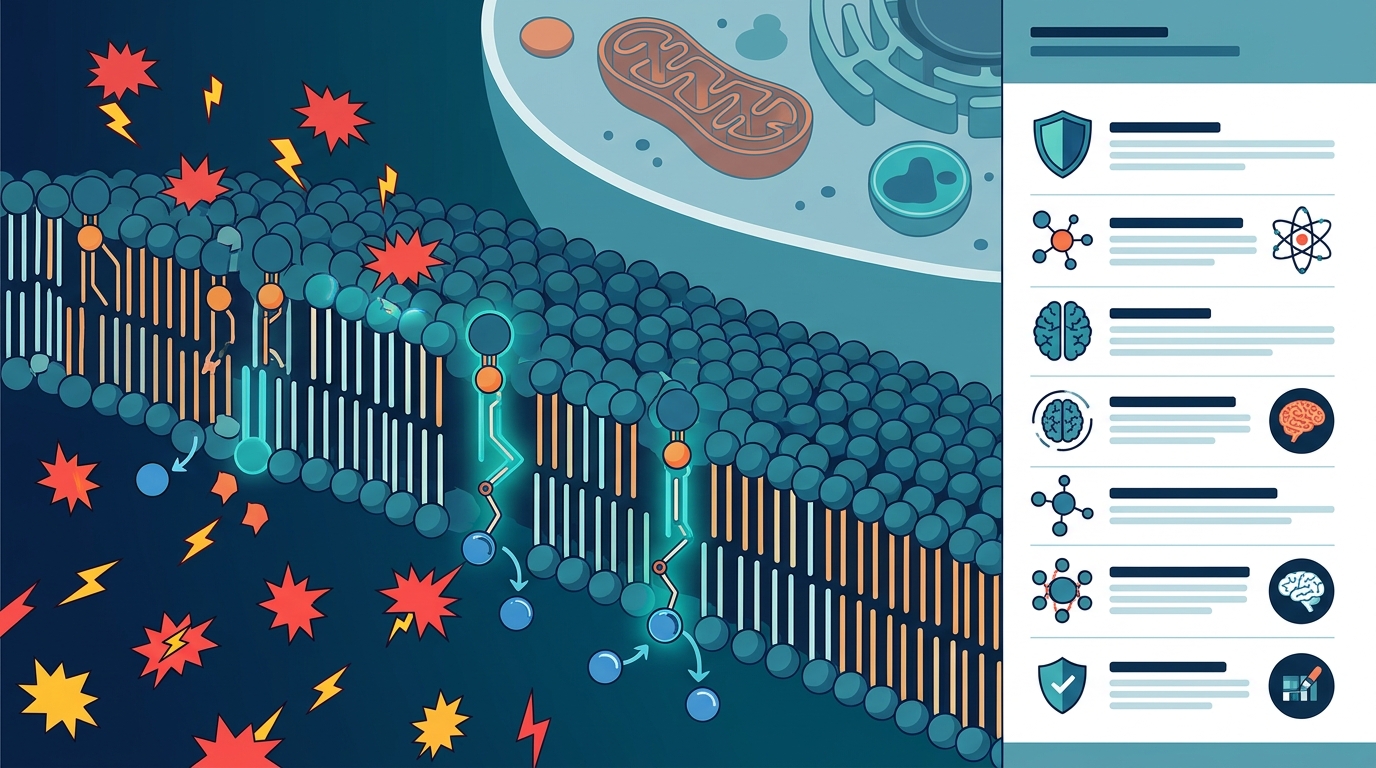
Plasmalogens shield cells from oxidative stress by acting as sacrificial antioxidants within cell membranes. Their unique vinyl ether bond absorbs reactive oxygen species, preventing lipid peroxidation and preserving membrane integrity. This protective mechanism is critical for tissues with high metabolic demands, such as the brain and heart, where oxidative damage can lead to cellular decline and disease.
The Vinyl Ether Bond as a Chemical Shield
The defining feature of a plasmalogen is a vinyl ether bond at the sn-1 position of the glycerol backbone. This structural difference separates plasmalogens from standard ester-linked phospholipids and grants them distinct biochemical properties. A plasmalogen is a specialized ether phospholipid that functions as a sacrificial antioxidant in cellular membranes.
When reactive oxygen species (ROS) attack cell membranes, they typically target lipid chains, initiating a chain reaction known as lipid peroxidation. This process damages the membrane structure and can lead to cell death. Plasmalogens intercept these attacks. The vinyl ether bond is highly susceptible to oxidation, meaning it reacts with ROS before the surrounding fatty acid chains do.
By absorbing the oxidative hit, the plasmalogen molecule is degraded or modified, but the rest of the membrane remains intact. This sacrificial role is a primary defense mechanism. It prevents the propagation of oxidative damage across the lipid bilayer. This is particularly important in tissues exposed to high levels of metabolic byproducts.
Membrane Architecture and Lipid Packing
Oxidative stress does not only damage individual molecules; it disrupts the physical organization of the cell membrane. Cell membrane fluidity is the measure of how easily lipids and proteins move within the lipid bilayer. Proper fluidity is essential for receptor signaling, nutrient transport, and vesicle fusion.
Plasmalogens influence membrane curvature and lipid packing due to their molecular shape. They help maintain the correct spacing and organization of other lipids and proteins. When oxidative stress depletes plasmalogens, the membrane can become rigid or disorganized. This structural disruption impairs the function of embedded proteins, including ion channels and transporters.
For example, in immune cells, membrane integrity is required for proper activation and signaling. If oxidative stress alters the lipid environment, immune cells may fail to respond correctly to threats. Plasmalogens help preserve the physical architecture that allows these biological processes to occur efficiently. This structural support is as important as the direct chemical scavenging of ROS.
Brain Health and Myelin Protection
The brain is one of the most metabolically active organs in the body, consuming a significant portion of the body's oxygen. This high metabolic rate generates substantial amounts of ROS. The brain is also rich in polyunsaturated fatty acids, which are highly susceptible to oxidative damage. Plasmalogens are exceptionally concentrated in brain tissue, particularly in myelin-rich white matter.
Myelin is a lipid-rich sheath that insulates nerve fibers, allowing for rapid signal transmission. Myelin integrity is the structural and functional stability of the insulating sheath surrounding axons. Oxidative stress can degrade myelin lipids, leading to demyelination and impaired neural communication. Plasmalogens protect myelin by scavenging ROS and maintaining the lipid composition of the sheath.
Research indicates that altered plasmalogen levels are observed in neurological conditions associated with oxidative stress. By preserving myelin structure, plasmalogens support cognitive function, memory, and motor control. This protective role is critical for long-term brain health. As we age, the brain's ability to manage oxidative stress may decline, making the presence of plasmalogens even more vital for maintaining neural resilience.
Mitochondrial Energy and Redox Balance
Mitochondria are the powerhouses of the cell, generating energy through oxidative phosphorylation. This process inevitably produces ROS as a byproduct. Mitochondrial membranes are rich in plasmalogens, which play a key role in maintaining mitochondrial function. Mitochondrial membrane potential is the electrical charge difference across the inner mitochondrial membrane, essential for ATP production.
Plasmalogens help maintain the structural integrity of mitochondrial membranes, ensuring that the electron transport chain functions efficiently. They also help regulate the local redox environment, preventing excessive ROS accumulation. When plasmalogen levels are low, mitochondrial membranes may become more vulnerable to oxidative damage. This can lead to impaired energy production and increased cellular stress.
Healthy plasmalogen levels support the balance between ROS production and antioxidant defense. This balance is crucial for cellular energy metabolism. In tissues like the heart and skeletal muscle, where energy demands are high, plasmalogens help ensure that mitochondria can sustain performance without succumbing to oxidative damage. This connection between membrane lipids and energy production highlights the systemic importance of plasmalogens.
Aging, Resilience, and Longitudinal Health
Aging is associated with a gradual decline in cellular resilience, partly due to cumulative oxidative damage. Plasmalogen levels tend to decrease with age in various tissues. This decline is linked to changes in peroxisomal function, which is the organelle responsible for plasmalogen biosynthesis. Cellular resilience is the ability of a cell to withstand and recover from stressors, including oxidative damage.
Advanced health measurement and lipidomics can help track plasmalogen levels over time. By monitoring these biomarkers, researchers and clinicians can gain insights into an individual's oxidative stress burden and membrane health. Longitudinal tracking is more powerful than one-time testing, as it reveals trends in biological aging. Understanding how plasmalogens change over time can inform strategies to support cellular resilience and healthy aging.
Plasmalogen Science emphasizes the importance of viewing plasmalogens within the context of broader lipid networks. They are not isolated molecules but part of a complex system involving peroxisomes, mitochondria, and inflammatory pathways. By focusing on the protective role of plasmalogens, we gain a deeper understanding of how cells defend themselves against the inevitable byproducts of metabolism. This knowledge is essential for developing strategies to promote longevity and maintain functional health.
Key Takeaways
- Plasmalogens act as sacrificial antioxidants, absorbing ROS to protect membrane lipids from peroxidation.
- The vinyl ether bond is the key structural feature that enables this protective chemical function.
- Plasmalogens maintain membrane fluidity and architecture, ensuring proper protein function and signaling.
- High concentrations in the brain and myelin protect neural communication and cognitive function.
- Mitochondrial membranes rely on plasmalogens to maintain energy production and redox balance.
- Plasmalogen levels decline with age, impacting cellular resilience and increasing vulnerability to oxidative stress.
- Longitudinal lipidomics can track plasmalogen trends to assess oxidative stress and aging biology.
Frequently Asked Questions
What is the primary mechanism by which plasmalogens protect against oxidative stress?
Plasmalogens protect against oxidative stress by acting as sacrificial antioxidants. Their vinyl ether bond reacts with reactive oxygen species, preventing these molecules from damaging other lipid chains in the membrane.
Why are plasmalogens particularly important in the brain?
The brain has high metabolic activity and is rich in polyunsaturated fatty acids, making it vulnerable to oxidative damage. Plasmalogens are highly concentrated in brain tissue, especially in myelin, where they protect neural structures and support cognitive function.
How do plasmalogens affect mitochondrial function?
Plasmalogens are abundant in mitochondrial membranes, where they help maintain structural integrity and regulate the local redox environment. This supports efficient energy production and prevents excessive ROS accumulation.
Do plasmalogen levels change with age?
Yes, plasmalogen levels generally decline with age. This decline is associated with changes in peroxisomal function and is linked to reduced cellular resilience and increased vulnerability to oxidative stress.
Can plasmalogen levels be measured?
Yes, plasmalogen levels can be measured using advanced lipidomics techniques. These tests can evaluate total plasmalogens, specific species, and ratios, providing insights into membrane health and oxidative stress status.
What is the relationship between plasmalogens and inflammation?
Plasmalogens influence inflammatory signaling pathways. By maintaining membrane integrity and regulating lipid mediators, they help modulate the inflammatory response. Altered plasmalogen levels have been observed in chronic inflammatory states.
How does oxidative stress impact cell membranes?
Oxidative stress can cause lipid peroxidation, which damages the membrane structure and disrupts fluidity. This impairs the function of embedded proteins and can lead to cell death if not controlled by antioxidants like plasmalogens.
Explore Plasmalogen Science Further
Understanding the protective role of plasmalogens is a key step in grasping cellular health and aging biology. For more in-depth information on how these specialized lipids function, visit What Do Plasmalogens Do? on Plasmalogen Science. You can also learn about the structural foundations in Cell Membranes Explained and explore the specific impacts on neural tissue in How Cognitive & Neurological Systems Are Affected in Plasmalogen Deficient Diseases. To understand the broader context of health measurement, read The Importance of Advanced Health Measurements in Health and Longevity. Plasmalogen Science provides comprehensive resources to help you navigate the complex world of lipid biology and cellular resilience.