

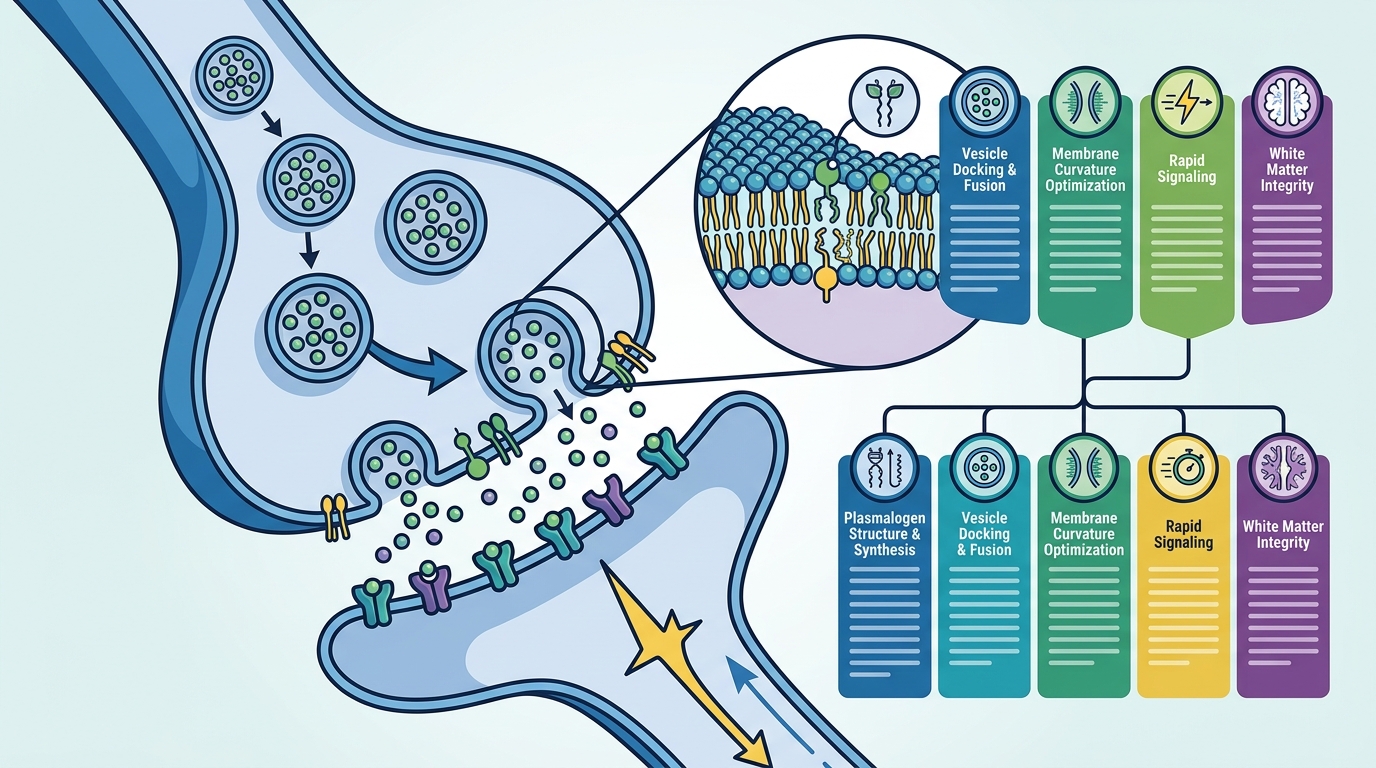
Plasmalogens accelerate synaptic vesicle fusion and signaling speed by optimizing membrane fluidity and curvature. Plasmalogen Science explains how these specialized ether lipids support rapid neurotransmitter release. This guide covers the molecular mechanics of synaptic transmission and the consequences of plasmalogen deficiency.
Neurotransmitter Release Speed
Neurotransmitter release is the primary mechanism of chemical communication in the nervous system. A synapse is the specialized junction where one neuron transmits a signal to a target cell. The speed of this transmission depends heavily on the physical properties of the presynaptic membrane. Plasmalogens are specialized ether phospholipids that are highly concentrated in neuronal membranes. Their unique molecular structure allows them to pack differently than standard ester phospholipids.
Membrane Curvature and Vesicle Docking
Synaptic vesicles must bend, dock, and fuse with the presynaptic membrane to release their contents. This process requires significant membrane curvature. Plasmalogens possess a conical shape due to their vinyl ether bond. This shape promotes the formation of highly curved membrane domains. These domains are essential for the rapid assembly of the fusion machinery. Without sufficient curvature, vesicle docking becomes slower and less efficient.
Fluidity and Protein Mobility
Signaling speed also depends on the lateral mobility of membrane proteins. Receptors and ion channels must move and interact within the lipid bilayer. Plasmalogens help maintain optimal membrane fluidity. They prevent the membrane from becoming too rigid. This fluidity ensures that synaptic proteins can reorganize quickly after each release event. The result is a faster reset time for the synapse, allowing for high-frequency signaling.
The Role of the Vinyl Ether Bond
The vinyl ether bond is the defining feature of plasmalogens. This bond is chemically distinct from the ester bonds found in most other phospholipids. It provides a unique biochemical identity to the lipid. This identity influences how plasmalogens interact with surrounding lipids and proteins. The bond also acts as a sacrificial antioxidant. It protects the membrane from oxidative damage that could otherwise slow down signaling. By preserving membrane integrity, plasmalogens support consistent signaling speed over time.
Plasmalogen Deficiency Effects
Plasmalogen deficiency disrupts the delicate balance of membrane composition. When plasmalogen levels drop, the physical properties of the synaptic membrane change. This can lead to slower neurotransmitter release and impaired synaptic plasticity. Plasmalogen Science highlights that these changes are not isolated to a single lipid class. They reflect broader shifts in membrane architecture and cellular stress.
Impaired Vesicle Fusion
Low plasmalogen levels reduce the ability of the membrane to form the necessary curvature for vesicle fusion. This can result in a delay in neurotransmitter release. The delay may be subtle in mild deficiency but significant in severe cases. Inherited peroxisomal disorders can cause profound plasmalogen deficiency. These conditions often present with neurological symptoms that include motor delays and cognitive impairment. The underlying cause is often the failure of the membrane to support rapid synaptic transmission.
Oxidative Stress and Membrane Damage
Plasmalogens are also critical for oxidative stress defense. The vinyl ether bond can be cleaved by reactive oxygen species. This cleavage releases a protective molecule that neutralizes further oxidative damage. When plasmalogens are low, this protective mechanism is compromised. The membrane becomes more susceptible to lipid peroxidation. Oxidative damage can alter the structure of synaptic proteins. This further impairs signaling speed and can lead to long-term synaptic dysfunction.
Impact on Myelin and White Matter
Plasmalogens are also abundant in myelin-rich tissue. Myelin is the lipid-rich sheath that insulates axons. It allows electrical signals to travel faster along the nerve fiber. Plasmalogen deficiency can affect the integrity of myelin. This can slow down signal conduction in the peripheral and central nervous systems. The combination of slower vesicle fusion and slower axonal conduction can significantly impact overall neural communication. This is why plasmalogen levels are increasingly studied in the context of neurological health and aging.
| Factor | Healthy Plasmalogen Status | Low Plasmalogen Status |
|---|---|---|
| Membrane Curvature | High, supports rapid vesicle docking | Reduced, slows vesicle fusion |
| Membrane Fluidity | Optimal, allows protein mobility | Altered, may restrict protein movement |
| Oxidative Defense | Strong, protects membrane integrity | Weakened, increases lipid peroxidation |
| Signaling Speed | Fast and consistent | Slower and potentially inconsistent |
Key Takeaways
- Plasmalogens are specialized ether phospholipids critical for synaptic membrane structure.
- The vinyl ether bond gives plasmalogens a conical shape that promotes membrane curvature.
- Membrane curvature is essential for the rapid docking and fusion of synaptic vesicles.
- Plasmalogens maintain membrane fluidity, which supports the mobility of synaptic proteins.
- Plasmalogen deficiency can slow neurotransmitter release and impair synaptic plasticity.
- The vinyl ether bond also provides antioxidant protection, preserving membrane integrity.
- Plasmalogens are abundant in myelin, supporting fast signal conduction along axons.
- Monitoring plasmalogen levels may provide insights into neurological health and aging.
Frequently Asked Questions
What is a plasmalogen?
A plasmalogen is a specialized ether phospholipid found in cell membranes. It contains a vinyl ether bond at the sn-1 position of the glycerol backbone. This structure distinguishes it from standard ester phospholipids.
How do plasmalogens affect synaptic speed?
Plasmalogens affect synaptic speed by optimizing membrane fluidity and curvature. These properties allow synaptic vesicles to dock and fuse more rapidly. This leads to faster neurotransmitter release.
Why is the vinyl ether bond important?
The vinyl ether bond is important because it gives plasmalogens a unique shape and chemical reactivity. The shape promotes membrane curvature, while the reactivity provides antioxidant protection.
Can plasmalogen deficiency cause neurological symptoms?
Yes, plasmalogen deficiency can cause neurological symptoms. Severe inherited deficiencies are associated with motor delays, cognitive impairment, and seizures. These symptoms often result from impaired synaptic function and myelin integrity.
Where are plasmalogens most concentrated in the body?
Plasmalogens are most concentrated in the brain, heart, and immune cells. They are also abundant in skeletal muscle and myelin-rich tissue. These tissues have high metabolic and membrane demands.
How are plasmalogens measured?
Plasmalogens are measured using advanced lipidomics techniques. These methods can quantify total plasmalogens and specific plasmalogen species in blood or tissue samples. This allows for a detailed assessment of membrane lipid composition.
Do plasmalogens play a role in aging?
Yes, plasmalogens play a role in aging. Plasmalogen levels tend to decline with age. This decline is associated with changes in membrane integrity, oxidative stress, and neurological function. Studying plasmalogens may help understand the biology of healthy aging.
Conclusion
Plasmalogens are fundamental to the speed and efficiency of synaptic signaling. Their unique structure supports the membrane dynamics required for rapid neurotransmitter release. Plasmalogen Science provides a comprehensive resource for understanding these complex biological processes. By exploring the role of plasmalogens in synaptic function, we gain deeper insights into neurological health and disease. To learn more about the science of plasmalogens, visit Plasmalogen Science.