

Published by Plasmalogen Science · Ultimate Guide · Estimated reading time: 14 minutes
The Chemistry That Makes Plasmalogens Unique
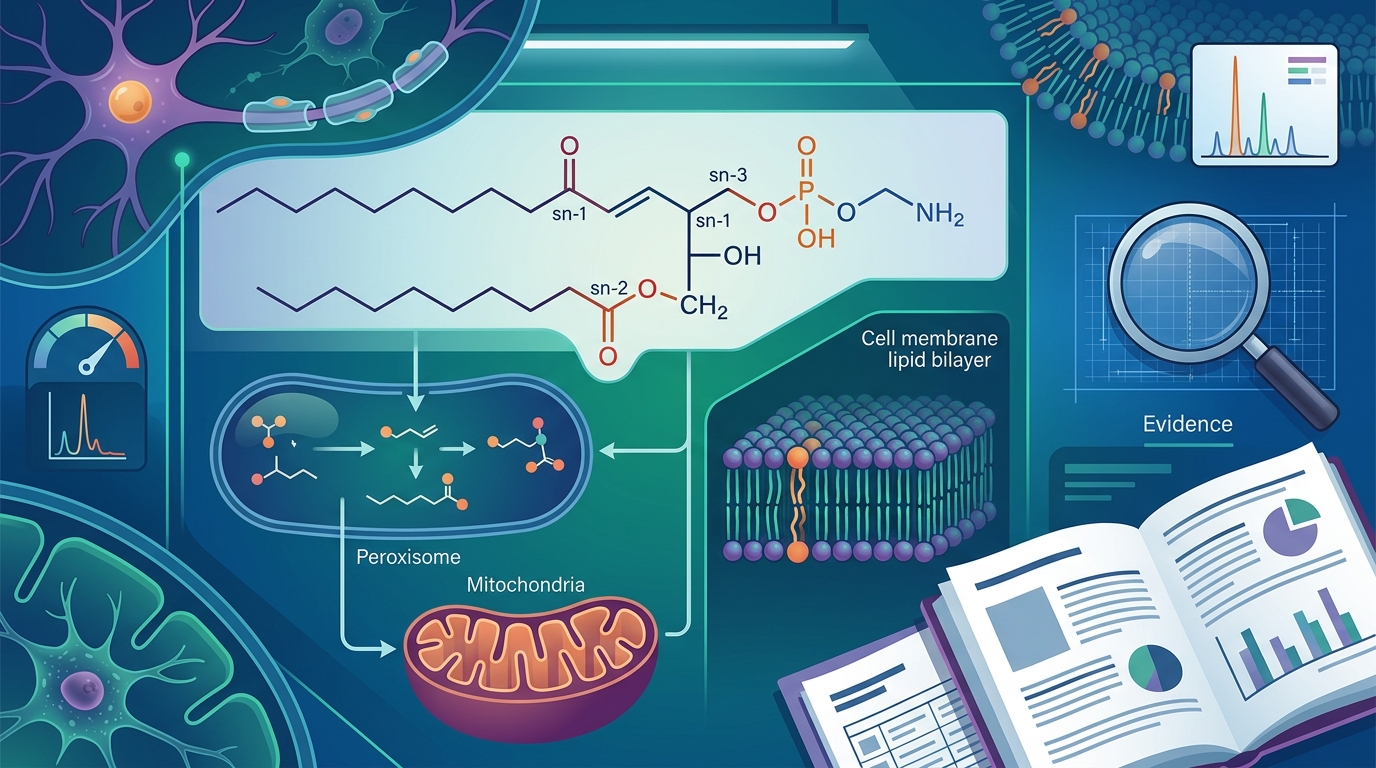
At first glance, a plasmalogen looks like any other phospholipid: a glycerol backbone, two hydrophobic tails, and a polar head group. The difference is subtle but consequential. Instead of a standard ester linkage at the sn-1 position, plasmalogens carry a vinyl-ether bond (–O–CH=CH–R). This single chemical distinction reshapes how the molecule behaves inside a membrane.
Plasmalogens are formally classified as glycerophospholipids with a vinyl-ether linkage at sn-1 and an ester bond at sn-2. The sn-2 position frequently hosts a polyunsaturated fatty acid (PUFA) such as docosahexaenoic acid (DHA) or arachidonic acid (AA). This arrangement makes plasmalogens major reservoirs of long-chain PUFAs that cells can mobilize for signaling, repair, and inflammatory resolution.
The two dominant classes found in humans are ethanolamine plasmalogens (PlsEtn) and choline plasmalogens (PlsCho), named for their head groups. These classes differ in half-life as well: choline plasmalogens turn over in roughly 30 minutes, while ethanolamine plasmalogens persist for about three hours, reflecting distinct metabolic roles.
Peroxisomal Biosynthesis: Where Plasmalogens Are Born
No discussion of plasmalogens is complete without the peroxisome—a small, single-membrane organelle responsible for initiating the entire synthesis pathway. The process begins when the enzyme glyceronephosphate O-acyltransferase (GNPAT) catalyzes the first committed step, followed by alkyldihydroxyacetone phosphate synthase (AGPS), which introduces the characteristic ether bond.
The partially assembled intermediate then travels to the endoplasmic reticulum (ER) for desaturation, head-group attachment, and sn-2 acylation. This two-organelle relay means that plasmalogen levels depend on both peroxisomal health and ER function.
What Happens When Peroxisomal Genes Fail
Mutations in peroxisomal biogenesis factors or in the enzymes GNPAT and AGPS cause rhizomelic chondrodysplasia punctata (RCDP), a severe congenital condition with profound plasmalogen deficiency. Additional peroxisomal disorders—Zellweger syndrome, cerebral adrenoleukodystrophy, and infantile Refsum disease—also feature disrupted plasmalogen metabolism, underscoring how critical these organelles are to ether lipid homeostasis.
Tissue-by-Tissue Distribution
Plasmalogens are not evenly distributed. Their abundance varies dramatically by tissue type, aligning with each tissue's functional demands.
| Tissue | Approximate Plasmalogen Share | Primary Head Group |
|---|---|---|
| Brain (gray matter) | ~20% of total glycerophospholipids | Ethanolamine |
| Myelin sheath | Up to 70% of ethanolamine glycerophospholipids | Ethanolamine |
| Heart | ~32% of glycerophospholipids | Choline & Ethanolamine |
| Immune cells (neutrophils) | High (exact % varies) | Choline |
| Skeletal muscle | Moderate | Ethanolamine |
The extraordinarily high concentration in myelin—up to 70% of ethanolamine glycerophospholipids—highlights the role plasmalogens play in maintaining the structural integrity of the insulating sheath around axons. The heart's 32% share reflects the membrane-intensive, energy-demanding nature of cardiac muscle.
Five Core Biological Functions
1. Membrane Architecture and Fluidity
The vinyl-ether bond causes the sn-1 chain to adopt a different angle relative to the membrane plane compared with ester-linked phospholipids. This geometry influences membrane curvature, packing, and lipid raft organization. Plasmalogens are important for the stability of lipid raft microdomains and cholesterol-rich membrane regions involved in cellular signaling.
2. Endogenous Antioxidant Defense
The vinyl-ether bond is inherently reactive toward reactive oxygen species (ROS). When ROS attack the bond, the plasmalogen is sacrificially consumed, sparing neighboring PUFAs and membrane proteins from oxidative damage. This antioxidant mechanism operates directly at the membrane surface—exactly where oxidative threats are most immediate.
3. PUFA Reservoir and Eicosanoid Precursor
Because the sn-2 position of plasmalogens commonly carries DHA or arachidonic acid, these molecules serve as reservoirs from which cells can release PUFAs for the synthesis of prostaglandins, thromboxanes, and other lipid mediators. This positions plasmalogens upstream of critical inflammatory and resolution pathways.
4. Cholesterol Homeostasis
Emerging evidence connects plasmalogens to cholesterol transport. Plasmalogen-containing phospholipids participate in the ABCA1-mediated cholesterol efflux that generates nascent HDL particles. Disruptions in plasmalogen levels may therefore affect reverse cholesterol transport and cardiovascular risk.
5. Cell Signaling and Membrane Trafficking
Plasmalogens modulate membrane dynamics in ways that affect vesicle formation, fusion, and receptor signaling. Their influence on lipid raft stability means that ion channels, G-protein-coupled receptors, and growth-factor receptors all operate in a plasmalogen-sensitive microenvironment.
When Levels Fall: Deficiency and Disease Associations
A consistent finding across clinical lipidomics research is the association between reduced plasmalogen levels and a range of diseases. The list continues to grow as measurement technology improves.
Neurodegeneration
Reductions of ethanolamine plasmalogen levels have been reported in the plasma, serum, cerebrospinal fluid, and brain tissue of Alzheimer's disease patients. Importantly, the magnitude of plasmalogen loss appears to track disease severity, ranging from approximately 10 mol% deficiency in very mild dementia to roughly 30 mol% deficiency in severe dementia. Plasmalogen deficiency is also documented in Parkinson's disease and multiple sclerosis, where the selective loss of peroxisomal function in oligodendrocytes mirrors white matter degradation.
Cardiovascular and Metabolic Disorders
Reduced circulating plasmalogens are associated with cardiovascular disease. Phospholipid plasmalogen levels have been studied as surrogate markers of oxidative stress, with lower levels correlating with poorer outcomes in patients on renal replacement therapy.
Cancer
Altered plasmalogen metabolism has been documented in breast cancer, ovarian cancer, and gastrointestinal malignancies. Some researchers have proposed plasmalogen ratios as part of prognostic lipid signatures.
Psychiatric Conditions
Dysfunctional plasmalogen dynamics have been observed in the plasma and platelets of patients with schizophrenia, adding a psychiatric dimension to the deficiency picture.
Plasmalogens in Lipidomics and Biomarker Science
Modern lipidomics—particularly shotgun mass spectrometry and liquid chromatography–mass spectrometry (LC-MS)—can now resolve individual plasmalogen molecular species by head group, chain length, and degree of unsaturation. This analytical power has opened the door to using specific plasmalogen species as clinical biomarkers.
A 2025 review in the Journal of Lipid Research characterized plasmalogens as both biomarkers and therapeutic targets, noting that reduced levels in circulation or in cell membranes are associated with rare peroxisomal disorders, systemic disease, neurological impairment, cancer, and diseases of the heart, kidney, and liver. The specificity challenge remains: because multiple diseases share the feature of plasmalogen depletion, researchers are working to identify signature molecular species unique to each condition.
The Age-Related Decline Curve
Plasmalogen levels are not static across a lifetime. They peak in early adulthood and gradually decline. This trajectory is influenced by several converging factors:
- Peroxisomal efficiency: The organelle's enzymatic capacity decreases with age, reducing de novo synthesis.
- Cumulative oxidative load: As the vinyl-ether bond scavenges ROS, net plasmalogen levels fall faster than they are replenished.
- Chronic inflammation: Low-grade systemic inflammation accelerates plasmalogen degradation through enzymatic and non-enzymatic pathways.
Data from the Rush University Memory and Aging Project illustrate the clinical significance of this decline: participants with higher plasmalogen levels exhibited a dementia risk profile comparable to individuals approximately ten years younger. This finding does not prove causation but draws a compelling correlation between lipid status and cognitive trajectory.
Dietary Sources and the Supplementation Frontier
Plasmalogens occur naturally in animal-based foods. Rich sources include organ meats (especially brain and heart tissue), shellfish, and marine invertebrates. Sea squirts (ascidians) have attracted particular research interest because of their high plasmalogen content.
Preclinical research published in 2025 showed that dietary plasmalogens improved spatial memory by approximately 44% in a mouse model of age-related cognitive decline and boosted synaptic proteins such as PSD-95 in the hippocampus while reducing markers of brain inflammation. Notably, plasmalogens outperformed other phospholipids like phosphatidylcholine and phosphatidylserine across cognitive and biochemical measures in this study.
Clinical evidence remains early-stage. Targeted plasmalogen supplementation has been shown to modulate blood levels of structurally specific plasmalogen species, but large-scale, placebo-controlled human trials are still needed before definitive therapeutic claims can be made.
A Note on Alkyl-Glycerol Precursors
Some supplementation strategies bypass the peroxisomal bottleneck by supplying alkyl-glycerol precursors. Animal studies have demonstrated that these precursors can raise plasmalogen levels even in models with peroxisomal gene knockouts, offering a potential route for individuals with compromised biosynthetic capacity.
Key Takeaways
- Plasmalogens are vinyl-ether glycerophospholipids that constitute 15–20 mol% of all phospholipids in human tissues, with the highest concentrations in the brain, heart, myelin, and immune cells.
- Their biosynthesis starts in peroxisomes and finishes in the endoplasmic reticulum. Genetic defects in this pathway cause severe disease.
- The vinyl-ether bond acts as a sacrificial antioxidant, protects neighboring membrane lipids and proteins from ROS, and shapes membrane geometry and fluidity.
- Plasmalogen deficiency is associated with Alzheimer's disease, Parkinson's disease, cardiovascular disease, certain cancers, and psychiatric conditions.
- Lipidomics now allows precise measurement of individual plasmalogen species, advancing their use as biomarkers.
- Levels decline with age. Preclinical data on dietary and precursor-based supplementation are promising, but human clinical evidence is still developing.
Frequently Asked Questions
What exactly are plasmalogens?
Plasmalogens are a subclass of glycerophospholipids distinguished by a vinyl-ether bond at the sn-1 position. They make up roughly 15–20 mol% of phospholipids in human tissues and are especially enriched in the brain, heart, and immune cells.
How are plasmalogens synthesized in the body?
Biosynthesis begins in peroxisomes via the enzymes GNPAT and AGPS, which create the ether linkage. The intermediate then moves to the endoplasmic reticulum for final modifications. Mutations in peroxisomal genes can cause fatal diseases like rhizomelic chondrodysplasia punctata (RCDP).
Why do plasmalogen levels decline with age?
The decline results from reduced peroxisomal enzyme activity, cumulative oxidative stress that degrades the vinyl-ether bond, and chronic low-grade inflammation. This drop is linked to increased risk of neurodegeneration, cardiovascular disease, and metabolic dysfunction.
Can plasmalogens serve as biomarkers for disease?
Yes. Reduced circulating plasmalogens have been measured in blood, cerebrospinal fluid, and tissue from patients with Alzheimer's disease, Parkinson's disease, cardiovascular conditions, and certain cancers. Modern lipidomics platforms can quantify specific plasmalogen species for diagnostic or prognostic purposes.
Are there dietary sources of plasmalogens?
Plasmalogens are found in animal-derived foods, particularly organ meats, shellfish, and marine invertebrates like sea squirts. Preclinical and early clinical studies are investigating whether oral supplementation can meaningfully restore depleted levels in humans.