

A growing body of peer-reviewed research links depleted plasmalogen levels to the onset and progression of Alzheimer's disease (AD) and Parkinson's disease (PD). This guide examines the evidence connecting these unique vinyl-ether phospholipids to neurodegeneration, explains the biological mechanisms at play, and reviews the emerging therapeutic strategies aimed at restoring plasmalogen balance in the brain.
What Are Plasmalogens?
Plasmalogens are a subclass of glycerophospholipids distinguished by a vinyl-ether bond at the sn-1 position of the glycerol backbone. Unlike conventional ester-linked phospholipids, this unique chemical bond gives plasmalogens special properties: they serve as endogenous antioxidants, influence membrane fluidity, and participate in cellular signaling. The two most biologically significant forms are ethanolamine plasmalogens (PlsEtn) and choline plasmalogens (PlsCho).
Plasmalogens are synthesized exclusively in peroxisomes, making these organelles central to plasmalogen homeostasis. Because there is no redundant biosynthetic pathway, any age- or disease-related decline in peroxisomal function directly depletes plasmalogen pools throughout the body—including the brain.
Why the Brain Depends on Plasmalogens
The human brain is one of the most plasmalogen-rich organs. Up to 30% of the phospholipid mass of neuronal membranes consists of plasmalogens, and the concentration is even higher in myelin-rich white matter. These lipids are essential for:
- Synaptic vesicle fusion: Plasmalogens facilitate the membrane curvature needed for neurotransmitter release at synapses.
- Myelin sheath integrity: White matter contains the highest concentration of plasmalogens in the body, making it particularly vulnerable to plasmalogen depletion.
- Antioxidant defense: The vinyl-ether bond scavenges reactive oxygen species, shielding polyunsaturated fatty acids like DHA from peroxidation.
- Cholesterol regulation: Plasmalogens modulate intracellular cholesterol distribution, influencing amyloidogenic processing pathways.
Plasmalogen Deficiency in Alzheimer's Disease
The connection between plasmalogens and Alzheimer's disease has been documented across multiple independent studies spanning decades.
Early-Stage White Matter Losses
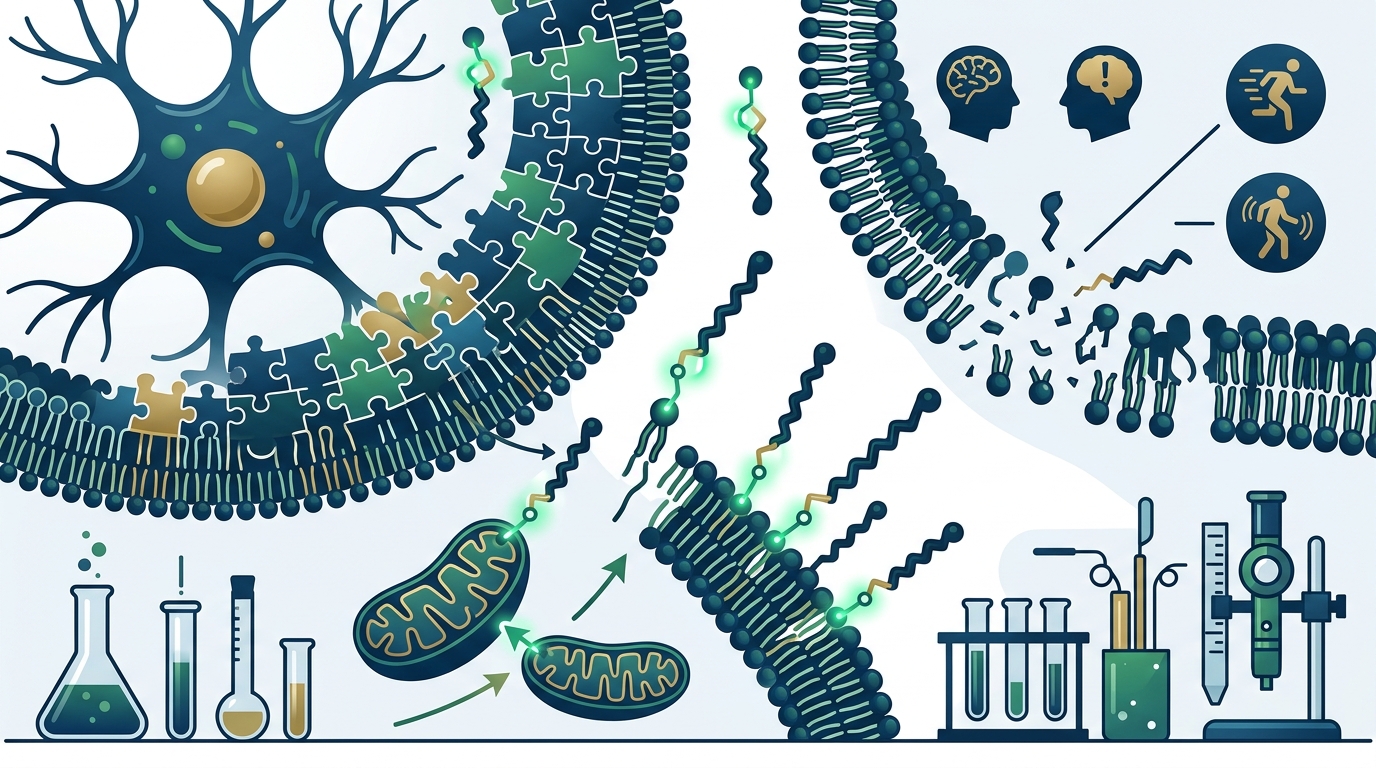
A landmark study by Han, Holtzman, and McKeel (2001) used electrospray ionization mass spectrometry to systematically examine plasmalogen content across brain regions at various stages of AD. The researchers found a dramatic decrease in plasmalogen content—up to 40 mol% of total plasmalogen—in white matter at a very early stage of AD (CDR 0.5, or very mild dementia). In gray matter, the deficiency correlated with disease severity, ranging from approximately 10 mol% at CDR 0.5 to approximately 30 mol% at CDR 3 (severe dementia). These results suggest plasmalogen deficiency may play an important role in AD pathogenesis, particularly in white matter.
Membrane Phospholipid Disruption
Research has shown that ethanolamine plasmalogens are decreased while serine glycerophospholipids are significantly increased in plasma membranes of affected brain regions in Alzheimer's disease. This shift may be driven by the stimulation of a calcium-independent plasmalogen-selective phospholipase A2 enzyme, which could be responsible for excess release of arachidonic acid and accumulation of prostaglandins and lipid peroxides—all contributing to neurodegeneration.
Serum Biomarkers and Disease Correlation
Peripheral blood measurements offer a less invasive window into brain plasmalogen status. Research published in the Journal of Lipid Research demonstrated that postmortem measurements of membrane ethanolamine plasmalogen content in the cortex and hippocampus correlate with the severity of dementia. Critically, subjects with confirmed AD exhibited significant decreases in white matter PlsEtn content in all brain regions, independent of regional amyloid-beta load. This finding strongly suggests that plasmalogen deficiency precedes the clinical course of AD rather than simply being a byproduct of the disease.
Beyond AD: A Broader Pattern
Although plasmalogen deficiency is consistently demonstrated in AD, it is also seen in other neurodegenerative diseases, which has prompted important questions about specificity versus shared pathological mechanisms across conditions.
Plasmalogen Deficiency in Parkinson's Disease
The evidence linking plasmalogen depletion to Parkinson's disease has expanded significantly in recent years.
Reduced Levels in Brain and Blood
Decreased plasmalogens are reported in the brain and blood of Parkinson's disease patients. A preliminary clinical study confirmed that initial levels of plasma ethanolamine ether phospholipids in PD patients were lower than those of age-matched normal controls.
Alpha-Synuclein and Membrane Dysfunction
One of the most intriguing connections involves alpha-synuclein, the protein whose aggregation forms Lewy bodies—a hallmark of PD. Plasmalogen levels are associated with maintaining normal alpha-synuclein interaction with the presynaptic membrane, and adequate plasmalogen concentrations appear to reduce the propensity for synuclein fibril formation. When plasmalogen levels drop, impaired vesicular fusion and neurotransmitter protein binding follow, accelerating dopaminergic neuronal loss.
Gut-Brain Axis
Parkinson's disease is increasingly recognized as having systemic manifestations. Changes in the gut—including increased inflammation and impaired dopaminergic function—are among the earliest symptoms of the disease, and plasmalogen status may influence this gut-brain connection.
Mechanistic Pathways: How Plasmalogen Loss Drives Neurodegeneration
Multiple converging mechanisms explain why reduced plasmalogen levels contribute to neuronal damage:
1. Oxidative Stress Amplification
Plasmalogens act as sacrificial antioxidants. Their vinyl-ether bond preferentially reacts with reactive oxygen species, protecting neighboring polyunsaturated fatty acids. When plasmalogens are depleted, this antioxidant shield weakens, and oxidative damage to membranes accelerates—a well-established contributor to both AD and PD pathology.
2. Neuroinflammation
Changes in plasmalogen levels alter membrane properties and signaling pathways involved in the inflammatory cascade. The excess arachidonic acid released from degraded plasmalogens feeds into prostaglandin synthesis, amplifying neuroinflammation. Research has shown that plasmalogen replacement therapy can be a successful anti-inflammatory strategy as well as ameliorating several pathological hallmarks of neurodegenerative disease.
3. Membrane Cholesterol Accumulation
Age-associated increases in membrane cholesterol result in decreased membrane fluidity, decreased ion channel function, and altered activity of enzymes like alpha-secretase. Plasmalogen deficiency exacerbates this problem, as plasmalogens normally help regulate cholesterol distribution within the cell membrane. Cholesterol accumulation in brain membranes occurs in an AD severity-dependent manner.
4. Mitochondrial Dysfunction
Plasmalogens are critical components of mitochondrial membranes. Their loss compromises mitochondrial membrane potential and energy production, contributing to the bioenergetic failure that characterizes neurodegenerative neurons.
5. Impaired Signal Transduction
Experimental evidence demonstrates links between plasmalogen levels and several common signaling players like protein kinase C, peroxisome proliferator-activated receptors (PPARs), and mitogen-activated protein kinases (MAPKs). Disruption of these pathways has far-reaching consequences for neuronal survival and plasticity.
Peroxisomal Dysfunction and Age-Related Decline
Because plasmalogen synthesis occurs via a single nonredundant peroxisomal pathway, peroxisomal health is the rate-limiting factor in plasmalogen production. Peroxisomal function naturally declines with aging, and the largest risk factor for both AD and PD is advancing age.
A 2024 study created a novel inducible animal model with a tamoxifen-inducible knockout of the Gnpat gene—encoding the first step in the plasmalogen biosynthetic pathway. Treatment in adult animals resulted in significant reduction of plasmalogens in both circulation and tissues as early as four weeks. By four months, changes in behavior and nerve function were observed, with strong correlations between residual brain plasmalogen levels, hyperactivity, and latency. This model provides compelling evidence that plasmalogen deficiency alone is sufficient to produce neurodegenerative-like changes in adult brains.
Therapeutic Approaches: Plasmalogen Replacement and Augmentation
The consistent finding of plasmalogen deficiency across multiple neurodegenerative conditions has prompted several therapeutic strategies.
Oral Ether Phospholipid Supplementation
A preliminary clinical report on PD patients found that oral administration of 1 mg/day of purified scallop-derived ether phospholipids increased plasma ether phospholipid levels to near-normal after 24 weeks, with concomitant improvement in some clinical symptoms.
Plasmalogen Precursor Therapy (PPI-1011)
In a mouse model of PD, the DHA-plasmalogen precursor PPI-1011 protected against MPTP-induced reduction in neurotransmitter levels (serotonin and dopamine) and maintained normal binding efficiency of critical vesicular neurotransmitter transporters (VMAT2 and DAT). This supports a disease-modifying effect rather than merely symptomatic relief.
Intranasal Nanoparticle Delivery
A 2024 study developed liquid crystalline lipid nanoparticles for intranasal delivery of scallop-derived plasmalogens in a transgenic PD mouse model. The treatment led to improvement of behavioral PD symptoms and downregulation of inflammatory genes (Il6, Il33, and Tnfa). RNA sequencing and lipidomic analyses established significant effects on lipid metabolism and neuroregeneration-related gene expression.
Alkylglycerol Precursors
Research has shown that feeding alkyl glycerol precursors to plasmalogen-deficient animals can significantly increase plasmalogen levels and arrest disease progression in affected tissues, offering another potential pathway to restore plasmalogen homeostasis.
Key Takeaways
- Plasmalogen deficiency occurs early in both Alzheimer's and Parkinson's disease, often before clinical symptoms are evident—suggesting a causal or contributing role rather than a mere consequence.
- White matter is particularly vulnerable to plasmalogen depletion, and white matter lesions are among the earliest detectable changes in AD.
- Multiple mechanisms—oxidative stress, neuroinflammation, cholesterol dysregulation, mitochondrial impairment, and alpha-synuclein aggregation—converge around plasmalogen loss.
- Peroxisomal decline with aging represents the upstream bottleneck in plasmalogen biosynthesis, linking age to neurodegeneration risk.
- Emerging therapies—including oral ether phospholipids, plasmalogen precursors, and intranasal nanoparticle formulations—show promise in restoring plasmalogen levels and improving neurological outcomes in preclinical and early clinical settings.
- Serum plasmalogen levels may serve as accessible biomarkers for early detection and monitoring of neurodegenerative disease progression.
Frequently Asked Questions
Are plasmalogens directly responsible for Alzheimer's or Parkinson's disease?
Current evidence strongly associates plasmalogen deficiency with both diseases, but the relationship is complex. Some data suggest that plasmalogen loss precedes clinical symptoms and may contribute causally, while other researchers note that deficiency is seen across multiple neurodegenerative conditions, making it more likely a shared vulnerability factor than a sole cause.
Can measuring blood plasmalogen levels predict Alzheimer's risk?
Research indicates that serum ethanolamine plasmalogen levels correlate with dementia severity and may reflect brain plasmalogen status. While not yet a routine clinical test, blood plasmalogen measurements show potential as an early biomarker for AD risk assessment.
What causes plasmalogen levels to decline with age?
Plasmalogen biosynthesis depends entirely on peroxisomes, and peroxisomal function naturally diminishes with aging. Since there is no alternative biosynthetic pathway, any decline in peroxisomal activity directly reduces plasmalogen production throughout the body, including the brain.
Can supplementing with plasmalogens improve symptoms of Parkinson's disease?
Preliminary clinical data show that oral administration of scallop-derived ether phospholipids can raise blood plasmalogen levels and improve certain clinical symptoms in PD patients. However, larger controlled trials are needed before definitive therapeutic recommendations can be made.
How do plasmalogens protect against alpha-synuclein aggregation?
Adequate plasmalogen levels help maintain normal alpha-synuclein interaction with presynaptic membranes and reduce the tendency for synuclein proteins to form pathological fibrils. When membrane plasmalogen content drops, alpha-synuclein is more likely to misfold and aggregate into Lewy bodies.
What is the difference between plasmalogen replacement and plasmalogen precursor therapy?
Plasmalogen replacement involves supplying intact plasmalogens (often derived from marine sources like scallops), while precursor therapy provides metabolic building blocks (such as alkylglycerols or the DHA-plasmalogen precursor PPI-1011) that the body's peroxisomes can convert into plasmalogens. Both strategies aim to restore depleted plasmalogen levels.