

Plasmalogens are among the most abundant phospholipids in the human nervous system, yet they remain one of the least discussed. This guide explains how these specialized ether lipids maintain cell membrane architecture, protect neurons from oxidative damage, and preserve the myelin sheath that keeps brain signals fast and reliable.
What Are Plasmalogens?
Plasmalogens are a class of glycerophospholipids distinguished by a vinyl-ether bond at the sn-1 position of the glycerol backbone. This single structural difference from conventional phospholipids gives them unique biophysical and chemical properties that influence virtually every membrane in the body.
Two principal types exist in mammalian tissues: ethanolamine plasmalogens (PlsEtn) and choline plasmalogens (PlsCho). In most tissues, ethanolamine plasmalogens are far more abundant—exceeding choline plasmalogens by roughly tenfold—with the notable exception of cardiac and skeletal muscle, where choline plasmalogens dominate.
In terms of overall prevalence, plasmalogens constitute approximately 5–20 percent of all phospholipids in most mammalian cell membranes. In neural tissues, however, they are present at dramatically higher concentrations: ethanolamine plasmalogens represent about 30 mol% of total brain phospholipids and approximately 70 percent of all glycerophospholipids in myelin.
Plasmalogens and Cell Membrane Architecture
Cell membranes are far more than passive barriers. They serve as dynamic control surfaces that coordinate nutrient exchange, waste removal, signal transduction, and receptor activity. Plasmalogens contribute to this functionality in several measurable ways.
Fluidity, Curvature, and Lateral Pressure
Research in biophysics has demonstrated that plasmalogens alter the curvature, fluidity, rigidity, thickness, and lateral pressure of cell membranes. They also modulate the activity of integral membrane proteins by interacting directly with them. This capacity to fine-tune the physical environment of the lipid bilayer makes plasmalogens indispensable for receptor signaling and ion channel function.
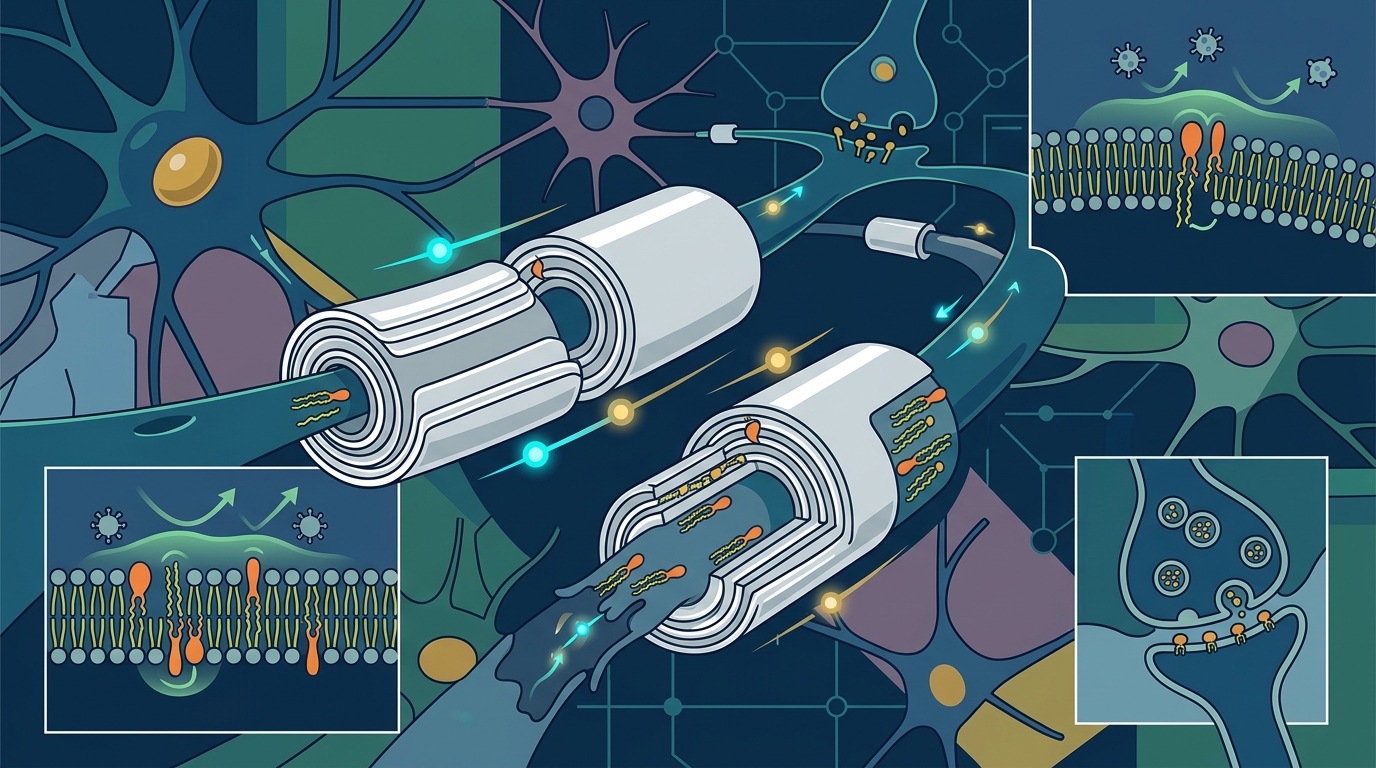
Lipid Raft Organization and Membrane Trafficking
The characteristic vinyl-ether moiety gives plasmalogen molecules properties that modulate membrane trafficking, lipid raft organization, and oxidative states within the bilayer. Lipid rafts—small, ordered microdomains enriched in cholesterol and sphingolipids—rely on surrounding phospholipid composition for proper assembly. When plasmalogen levels are sufficient, these rafts organize efficiently, supporting processes ranging from neurotransmitter release to growth factor signaling.
PUFA Reservoir Function
Plasmalogens are enriched in polyunsaturated fatty acids (PUFAs) such as docosahexaenoic acid (DHA) and arachidonic acid (AA) at the sn-2 position of their glycerol backbone. This makes them functional reservoirs of bioactive lipid mediators that can be released upon hydrolysis. DHA-containing plasmalogens are the most abundant plasmalogen species in cerebral cortex membranes, directly linking membrane composition to anti-inflammatory and pro-resolving signaling.
How Plasmalogens Support Brain Function
The brain is extraordinarily rich in plasmalogens. Ethanolamine plasmalogens account for over 50 percent of the total ethanolamine phosphoglycerides in gray matter and over 85 percent of those in myelin. This concentration is not incidental—it reflects the brain's reliance on these lipids for core operations.
Synaptic Transmission and Vesicle Fusion
Plasmalogens play important roles in vesicle fusion necessary for synaptic neurotransmitter release. Every time a neuron fires, synaptic vesicles must merge with the presynaptic membrane to release their neurotransmitter payload. Plasmalogens facilitate this fusion event by promoting non-lamellar hexagonal phase structures that lower the energy barrier for membrane merging. Without adequate plasmalogens, synaptic efficiency declines.
Neuronal Communication and Signal Speed
In the brain, plasmalogens foster efficient synaptic transmission and contribute to the formation and maintenance of myelin sheaths around nerve fibers. They support the integrity of both gray matter—where thinking, memory, and information processing occur—and white matter, the myelin-coated nerve fibers that transmit signals across brain regions.
Cognitive Performance and Plasmalogen Status
Data from the Rush University Memory and Aging Project reveal strong correlations between higher plasmalogen levels and reduced dementia risk, pointing to a meaningful relationship between plasmalogen status and cognitive longevity. When plasmalogen levels are optimal, people tend to experience clearer thinking, better focus, and improved memory recall.
Plasmalogens and Myelin Integrity
Myelin is the lipid-rich insulating sheath that wraps nerve axons, enabling rapid saltatory conduction of electrical impulses. The relationship between plasmalogens and myelin is among the most well-characterized in lipid biology.
Composition of the Myelin Sheath
Plasmalogens are a subclass of phospholipids primarily found in myelin that are proposed to enhance myelin compaction and stability. Up to 70 percent of the ethanolamine glycerophospholipids in the myelin sheath are plasmalogens. The outer layers of myelin are especially rich in these lipids, giving the sheath a flexible, shock-absorbing quality that accommodates physical movement—head turns, spinal flexion, and whole-body motion.
Myelination During Development
Brain plasmalogen levels depend on the degree of myelination and increase rapidly during myelinogenesis. In the adult human brain, plasmalogens account for the major portion of ethanolamine glycerophospholipids—around 50 percent—whereas the newborn brain contains only about 7 percent. This dramatic increase during development underscores how tightly plasmalogen synthesis is coupled to myelin formation.
What Happens When Myelin Loses Plasmalogens
When plasmalogen levels drop by 20 to 30 percent, the myelin membrane becomes more vulnerable to oxidation. This forces glial cells—the brain's support and repair crew—to replace damaged lipid layers more frequently. That constant repair cycle is energy-intensive and diverts cellular resources from other critical tasks. In conditions like Rhizomelic Chondrodysplasia Punctata (RCDP), a rare genetic disorder of plasmalogen synthesis, myelination deficits, enlarged ventricles, and cerebellar atrophy are among the primary neurological abnormalities.
The Vinyl-Ether Bond: A Built-In Antioxidant Mechanism
One of the most distinctive features of plasmalogens is their role as sacrificial antioxidants. The hydrogen atoms adjacent to the vinyl-ether bond have relatively low dissociation energies, meaning they are preferentially oxidized over diacyl glycerophospholipids when exposed to free radicals and singlet oxygen. Plasmalogens are consumed in this reaction, sparing the oxidation of polyunsaturated fatty acids and other vulnerable membrane lipids.
This mechanism positions plasmalogens as the membrane's first line of defense against reactive oxygen species (ROS). In the brain, where metabolic activity is high and oxygen consumption is disproportionate to tissue mass, this sacrificial antioxidant function is particularly critical. When plasmalogen reserves are depleted, other cellular components absorb more oxidative damage, accelerating aging and impairing regeneration.
Peroxisomal Biosynthesis: Where Plasmalogens Begin
Plasmalogen synthesis begins in the peroxisome—a membrane-bound organelle involved in fatty acid oxidation and lipid metabolism. The pathway starts with the association of two peroxisomal matrix enzymes: glyceronephosphate O-acyltransferase (GNPAT) and alkylglycerone phosphate synthase (AGPS). These enzymes work on the luminal side of the peroxisomal membrane and interact to increase efficiency.
The first step, catalyzed by GNPAT, acylates dihydroxyacetone phosphate (DHAP) at the sn-1 position. AGPS then exchanges the acyl group for an alkyl group. The resulting intermediate is reduced to 1-O-alkyl-2-hydroxy-sn-glycerophosphate by an acyl/alkyl-DHAP reductase located in both peroxisomal and endoplasmic reticulum membranes. Subsequent steps in the endoplasmic reticulum complete the synthesis.
This pathway is non-redundant—there is no alternative biochemical route for producing the vinyl-ether bond. Consequently, any decline in peroxisomal function directly translates to reduced plasmalogen output, with downstream effects on every tissue that depends on these lipids.
Age-Related Plasmalogen Decline
Plasmalogen levels follow a distinctive arc across the human lifespan. They increase until about 30–40 years of age, after which they plateau briefly before entering a dramatic decline around age 70. After age 50, the brain becomes progressively more vulnerable to oxidative stress and inflammation as plasmalogen reserves diminish.
This decline is linked to reduced peroxisomal function. As peroxisomes lose efficiency with age, the rate-limiting enzymes GNPAT and AGPS produce fewer plasmalogen precursors. The tissues most sensitive to this shortfall—brain, heart, and lungs—show the earliest and most pronounced functional consequences.
Circulating plasmalogen levels are decreased in older individuals and are further decreased in Alzheimer's disease (AD) and Mild Cognitive Impairment (MCI). Reduced indices of plasmalogen biosynthesis are also significantly correlated with elevated cerebrospinal fluid concentrations of total tau, a biomarker of neurodegeneration.
Plasmalogen Deficiency and Neurodegeneration
The association between low plasmalogen levels and neurodegenerative disease has been documented repeatedly across independent cohorts.
Evidence in Alzheimer's Disease
Research using electrospray ionization mass spectrometry has demonstrated a dramatic decrease in plasmalogen content—up to 40 mol% of total plasmalogen—in white matter at very early stages of AD (Clinical Dementia Rating 0.5). In gray matter, the deficiency correlates with dementia severity, ranging from approximately 10 mol% at CDR 0.5 to roughly 30 mol% at CDR 3 (severe dementia).
Serum ethanolamine plasmalogen levels measured across five independent population collections comprising over 400 clinically demented and over 350 nondemented subjects showed that circulating PlsEtn levels were significantly decreased in subjects with Alzheimer's-type dementia at all stages of the disease.
Deficiency in Plasmalogen-Dependent Genetic Disorders
Deficiency in plasmenyl ethanolamine leads to disturbances of the myelin structure, synaptic neurotransmission and intracellular signaling, apoptosis of neurons, and neuroinflammation, accompanied by cognitive disturbances and aberrant behaviors in animal models. In RCDP, where plasmalogen synthesis is severely impaired from birth, the neurological consequences are profound and life-limiting.
Broader Neurodegenerative Context
Low plasmalogen levels have been linked not only to Alzheimer's but also to Parkinson's disease, multiple sclerosis, and psychiatric conditions including bipolar disorder and psychosis. This breadth of association suggests that plasmalogen deficiency represents a general vulnerability factor for the nervous system rather than a disease-specific biomarker.
Research Frontiers: Replacement Therapy and Animal Models
The therapeutic potential of plasmalogen restoration is an active area of investigation. Several lines of research are converging to clarify whether replenishing plasmalogens can prevent or reverse neurological damage.
Animal Models of Chronic Deficiency
In 2024, researchers published a novel inducible animal model using CRISPR technology to generate a tamoxifen-inducible knockout of the GNPAT gene. After only four months of plasmalogen deficiency, the animals showed changes in behavior and nerve function that correlated with residual brain plasmalogen levels. This model represents a significant advancement because it mimics the acquired plasmalogen deficiency of aging, rather than the congenital deficiency seen in RCDP models.
Precursor Supplementation Studies
Oral administration of plasmalogen precursors has shown promise. In one study, a single dose of DHA-containing alkyl-diacylglycerol (DHA-AAG) at 100 mg/kg increased circulating plasmalogen levels by 80 percent within 24 hours in healthy subjects. In a separate ascending-dose trial of 22 individuals with mild to moderate cognitive impairment, daily DHA-AAG administration increased serum DHA plasmalogens by more than twofold over the treatment period. A small trial of scallop-derived plasmalogens also reported improved memory function in patients with mild Alzheimer's disease at a dose of 1 mg/day.
Delivery Challenges
Effective delivery to the brain remains a substantial challenge due to the restrictive nature of the blood-brain barrier. Emerging nanomedicine approaches, including lipid nanoparticles and intranasal delivery, are being explored as strategies to improve plasmalogen bioavailability in neural tissues.
Key Takeaways
- Plasmalogens are essential membrane phospholipids that constitute up to 70% of myelin glycerophospholipids and 30 mol% of total brain phospholipids.
- They regulate membrane biophysics—fluidity, curvature, thickness, lipid raft organization—and modulate integral membrane protein activity.
- The vinyl-ether bond functions as a sacrificial antioxidant, preferentially absorbing free radical damage to protect PUFAs and other vulnerable membrane components.
- Plasmalogen biosynthesis begins in the peroxisome via a non-redundant pathway; any decline in peroxisomal function directly reduces plasmalogen output.
- Levels peak around age 30–40 and decline significantly by age 70, correlating with increased vulnerability to neurodegeneration.
- Deficiency is documented at all stages of Alzheimer's disease, with white matter showing up to 40 mol% depletion even in very mild dementia.
- Precursor supplementation can raise circulating plasmalogen levels, though brain delivery remains a technical challenge under active investigation.
Frequently Asked Questions
What exactly are plasmalogens?
Plasmalogens are a subclass of glycerophospholipids characterized by a vinyl-ether bond at the sn-1 position of the glycerol backbone. They are found in cell membranes throughout the body but are especially concentrated in the brain, heart, and nervous system. The two main types are ethanolamine plasmalogens and choline plasmalogens.
Why are plasmalogens important for brain function?
The brain depends on plasmalogens for synaptic vesicle fusion, membrane fluidity, signal transduction, and antioxidant defense. Ethanolamine plasmalogens constitute over 50% of ethanolamine phosphoglycerides in gray matter and over 85% in myelin. Their depletion is consistently associated with cognitive decline and neurodegenerative disease.
How do plasmalogens protect against oxidative stress?
The vinyl-ether bond in plasmalogens has low dissociation energy, making it preferentially targeted by free radicals and singlet oxygen. Plasmalogens are consumed in this reaction, functioning as sacrificial antioxidants that spare other critical membrane lipids and proteins from oxidative damage.
What is the relationship between plasmalogens and myelin?
Plasmalogens are the dominant phospholipid in myelin, comprising up to 70% of myelin ethanolamine glycerophospholipids. They enhance myelin compaction and stability, provide flexibility to the sheath, and increase rapidly during the developmental phase of myelination. Deficiency leads to myelin structural disturbances and impaired nerve conduction.
Do plasmalogen levels decrease with age?
Yes. Plasmalogen levels increase until approximately age 30–40, then decline, with a particularly steep drop around age 70. This decline is attributed to reduced peroxisomal function and is associated with increased susceptibility to neurodegenerative conditions including Alzheimer's disease.
Can plasmalogen levels be restored through supplementation?
Early research is promising. Oral plasmalogen precursors such as DHA-AAG have been shown to increase circulating plasmalogen levels significantly. However, crossing the blood-brain barrier remains a challenge, and larger clinical trials are needed to confirm cognitive benefits in humans.
Are plasmalogens linked to Alzheimer's disease?
Multiple studies have found reduced plasmalogen levels in the brains and blood of Alzheimer's patients at all stages of the disease. White matter shows particularly severe depletion even in very mild dementia. Longitudinal evidence suggests that declining plasmalogen levels may precede and contribute to disease progression rather than being merely a consequence of it.